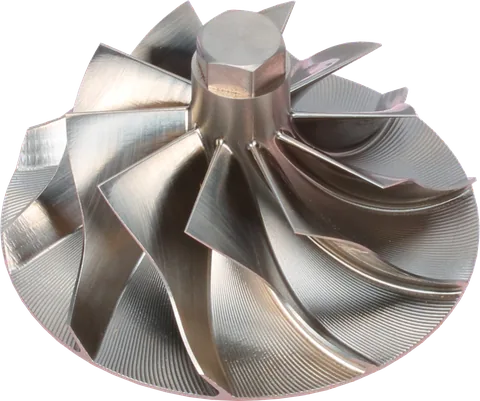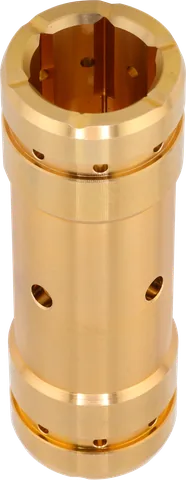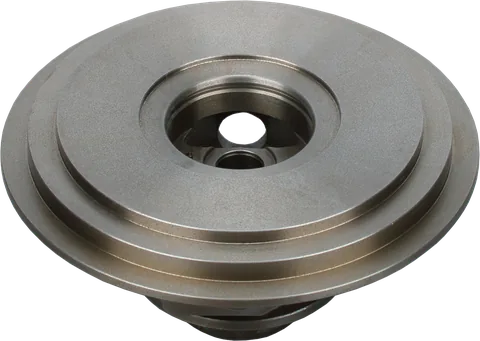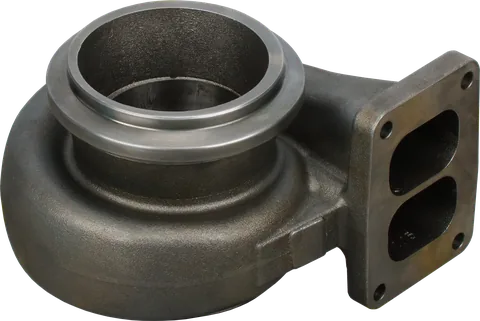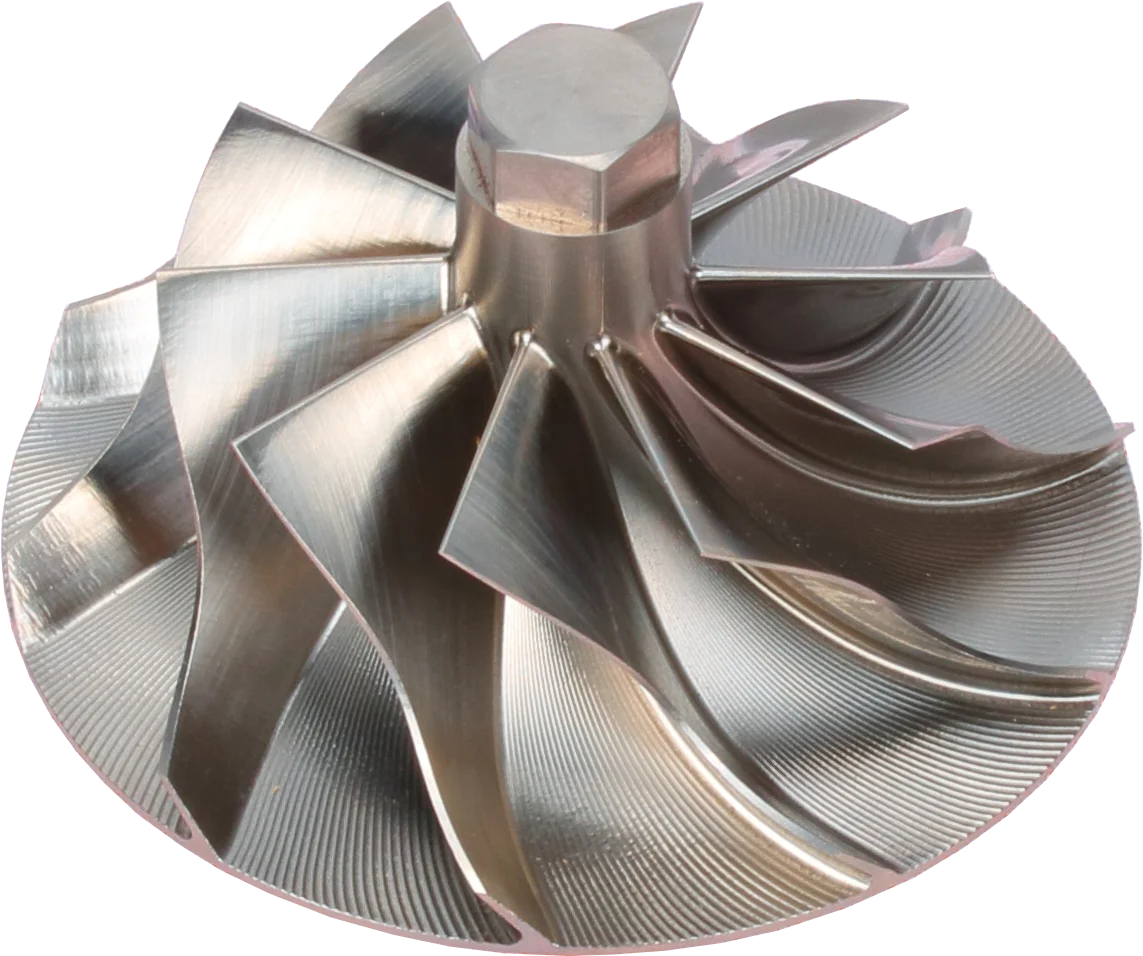
Two replacement wheels can share an outside diameter yet belong to different applications. One may have a larger inlet, a different blade arrangement, or a profile that cannot work with your existing cover. A trim number describes only one relationship within that hardware.
For a truck, pickup, excavator, or generator repair, start with the approved turbocharger assembly and component numbers. Use the dimensions to verify the replacement. Choosing by the largest advertised number can turn a routine repair into an airflow or clearance problem.
Turbocharger inducer vs exducer: what does compressor trim measure?
In normal compressor-wheel terminology, air enters near the shaft axis and leaves around the wheel’s outer edge. The inlet blade-tip circle is the smaller diameter; the discharge blade-tip circle is the larger one.
| Measurement | Location on the wheel | What to check |
|---|---|---|
| Compressor inducer | Inlet ends of the full-length blades | Measure the diameter of the blade-tip circle, not the cover opening. |
| Compressor exducer | Outer blade tips where air discharges | Confirm the supplier’s convention for extended-tip designs. |
| Blade exit height | Axial blade height at the discharge rim | Affects outlet geometry but is not used to calculate trim. |
Trim compares the circular areas represented by the two diameters. Divide the smaller diameter by the larger, square that result, and multiply by 100. Both measurements must use the same units.
Squaring matters because circle area increases with diameter squared. This is a nominal area relationship, not the actual open passage area: the hub and blades occupy space. A trim value therefore is neither an airflow rating nor an efficiency percentage.
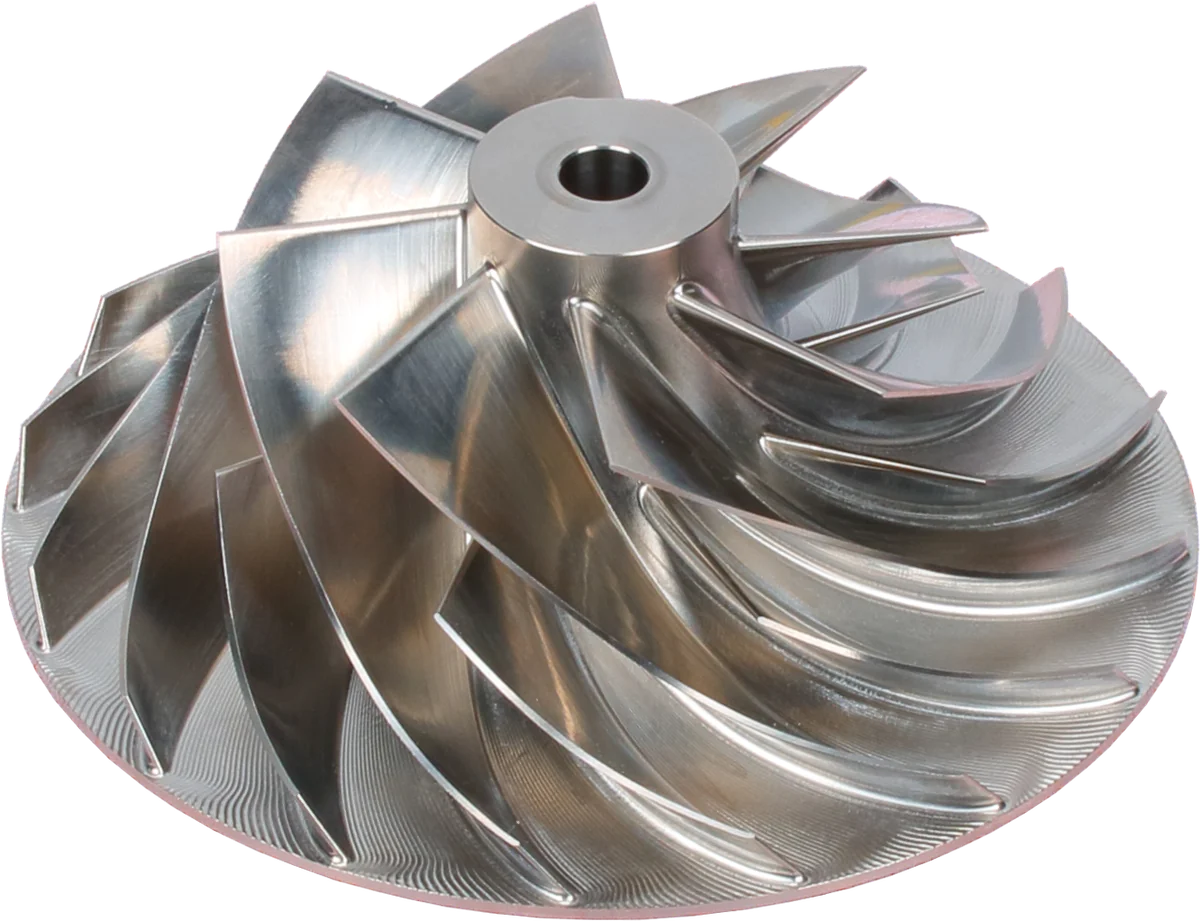
Blades: inspect for chips, bends and contact marks.
Hub: part of the balanced rotating assembly.
Outer blade tips: check for housing rub.
Product photograph from 2026. Numbers identify the features explained below.
How to calculate turbocharger compressor trim: worked example
The following round numbers are illustrative only; they do not identify a replacement part.
| Wheel | Inlet diameter | Outlet diameter | Calculated trim |
|---|---|---|---|
| A | 50 mm | 80 mm | 39.06 |
| B | 60 mm | 80 mm | 56.25 |
| C | 75 mm | 100 mm | 56.25 |
For Wheel B, divide 60 by 80 to get 0.75. Squaring 0.75 gives 0.5625; multiplying by 100 gives 56.25. A catalog might round that to 56, depending on its convention.
Wheels A and B share the same outlet diameter but have different inlet proportions. Wheel B has 44% more nominal inlet area because 60 squared divided by 50 squared is 1.44. That does not establish a 44% airflow increase.
Wheels B and C have equal trim values at different physical sizes. This is why a ratio cannot replace a complete compressor wheel size specification.
How compressor trim affects flow and pressure
Comparisons of turbocharger compressor trim and airflow make the most sense within a related wheel family using appropriate matching covers. With the exducer held constant, a larger inducer usually permits greater maximum air mass flow. A smaller inducer generally reduces that potential and can suit a lower-flow operating range.
A higher value achieved by reducing the exducer does not prove a larger inlet or greater airflow.
| Comparison | Typical tendency | Limit of the comparison |
|---|---|---|
| Larger inlet, same outlet diameter | Higher flow capacity; map coverage may extend rightward | Surge boundary and efficiency also change. |
| Smaller inlet, same outlet diameter | Lower flow capacity; useful region may move leftward | Do not assume better response or more boost. |
| Same ratio, different diameters | Different flow and speed capabilities | Equal trim does not imply equal maps. |
Pressure ratio describes absolute outlet pressure relative to absolute inlet pressure. A smaller inlet relative to the outlet can favor pressure development at lower flow in some designs. Raising the ratio of diameters may trade some pressure capability or efficiency for additional flow, but there is no universal pressure ranking by trim.
At a given shaft speed, exducer diameter influences blade-tip speed, while blade geometry and loading influence the pressure rise. The correct compressor map is needed to compare pressure capability at the required flow and within the speed limit.
Changing trim can reshape speed lines, shift efficient operating regions, and move both surge and high-flow limits. It does not simply stretch a map sideways. For a working diesel, check sustained load and lower-speed operation, including the points encountered when pulling through a gear or accepting generator load.
Flow capacity is the amount of air the compressor can support at an operating condition; it is not air the engine automatically consumes. A larger inlet will not necessarily improve low-speed pulling power if the engine’s required operating points fall in a less efficient or unstable region.
Why matching outside diameters can still hide different wheels
Even when both measured diameters agree, two wheels may have different outlet heights, blade angles, hub shapes, or clearances. Those details influence the available passages and how the air moves through them. Equal trim is not proof of equal performance.
Blade count is one clue, not a ranking. More blades can guide the air differently but also occupy passage area. Splitter blades begin farther downstream than the full-length blades, helping guide flow after the inlet without adding full-length leading edges there.
Backswept blades curve opposite the direction of rotation near the outlet. Straight radial blades use a different exit geometry. Neither style can be assessed from diameter measurements alone. Cast versus machined construction describes how a wheel is made; it does not guarantee improved airflow, durability, or suitability for a particular duty cycle.
For long service hours, retain the specified wheel material and approved speed capability. A light-looking wheel or a polished finish is not evidence that it can tolerate the thermal and loading cycles of a bus, irrigation pump, or work truck.
Reading a listing before you order
A useful specification ties the ratio to dimensions and a traceable part number. An unexplained “56 trim” label leaves too much unknown. Likewise, a two-number listing may use inducer/exducer order, but confirm the labels instead of assuming.
| Listing detail | What it tells you | What still needs confirmation |
|---|---|---|
| 56 trim | Rounded inlet-to-outlet area relationship | Both diameters and the exact component identity |
| 60/80 mm | Possibly inlet/outlet diameters | Measurement order and blade-tip convention |
| 6 + 6 blades | Often six full blades and six splitters | Supplier’s counting convention and matching application |
| Cast or billet | Manufacturing description | Geometry, approved fit, and material specification |
Those entries are illustrative shorthand, not a universal catalog standard. Ask whether the quoted map applies to the exact wheel and cover combination being supplied. When buying a CHRA, also confirm that its installed wheel is compatible with the cover you will retain.
If maps are unavailable for a service replacement, prioritize a documented application cross-reference. Do not infer an upgrade from dimensions alone.
The cover contour is part of the specification
The inside of the compressor cover follows the wheel’s blade profile. Its clearance must remain within the design specification from the inlet toward the outlet. Matching only the two end diameters cannot confirm that shape.
A mismatched contour may leave excessive gaps that reduce efficiency, or tight spots that allow rubbing. A wheel that turns freely during a bench check has not demonstrated adequate running clearance under operating speed and temperature.
Never mix a wheel with the wrong cover, even if the mounting hardware fits. Do not grind blades or casually enlarge a housing to make a substitute fit. Use a combination specified for the assembly, or a professionally engineered conversion with documented geometry and validated performance.
The wheel also needs the correct shaft attachment, backface, height, and relationship to the backplate. A compatible cover alone cannot validate the rest of the rotating assembly.
Practical checks for a diesel replacement
Treat measurements as confirmation of identity. They do not establish interchangeability by themselves. For a stock service repair, the correct application and assembly number should lead the selection.
- Record the turbocharger identification number, engine model, rating, and application. Similar engine families can use different specifications.
- Obtain a dimensioned drawing. Confirm where the supplier measures the inlet and outlet blade diameters, especially on extended-tip wheels.
- Measure a clean, accessible wheel with suitable precision tools, across its centerline at the specified blade tips. Do not force caliper jaws against thin edges or substitute the housing bore.
- Note damage before comparing dimensions. Bent tips, missing material, or rub wear can make a measurement misleading. Resolve conflicts using the drawing and part number.
- Verify the cover and backplate identifiers, wheel attachment, rotation, and outlet height. A photo and trim value are insufficient for interchange.
- Confirm the required assembly and balancing process with the rebuilder. A supplied component balance does not automatically validate the completed CHRA.
Record diesel turbocharger compressor wheel dimensions as supplied rather than rounding them to a convenient whole millimeter. A rounded size can help categorize a wheel, but it cannot establish working clearance. Ask for tolerances if the drawing is being used to assess physical compatibility.
For a complete replacement turbocharger, compare the full assembly specification rather than asking only about its wheel. Turbine configuration and boost-control hardware still determine whether the unit belongs on the engine; a matching compressor diameter cannot establish application compatibility.
Common Questions
Does 60 trim mean a 60 mm wheel?
No. Trim is a dimensionless area relationship. A 60-trim designation does not identify either diameter by itself. Ask for the inlet and outlet blade diameters in millimeters and the exact wheel part number.
Does a higher trim guarantee more boost?
No. Boost depends on the operating point and the complete turbocharger system. A higher value often supports greater airflow within a related wheel family, but pressure capability must be checked against the correct compressor map and speed limit.
Can I replace a cast wheel with a billet wheel?
Only when the replacement is specified as compatible with that turbocharger assembly. Manufacturing method does not establish compatibility. Confirm the cover contour, attachment, wheel height, backface geometry, material specification, and required balancing procedure.
Why does my calculated trim differ from the catalog?
Possible reasons include rounding, measuring a backing disc instead of the blade tips, wheel damage, or an incorrect listing. Extended-tip designs also require the supplier's measurement convention. Resolve the discrepancy before ordering.
Can turbocharger compressor trim fix low boost?
Diagnose the fault first. Intake leaks, restrictions, control problems, or turbine-side issues can reduce boost. Installing a different wheel may add a mismatch without correcting the cause. Restore the approved specification unless a complete engineering match supports a change.
Which turbocharger compressor wheel should I buy?
Start with the approved turbocharger assembly and component numbers. Confirm both blade-tip diameters, cover contour, shaft attachment, backface geometry, and wheel height. A trim value alone does not establish compatibility.
Contact LeadTurbo with the turbocharger part number, engine details, and any available wheel and cover specifications for help checking a replacement.