A truck pulling away in a tall gear or a loader pushing into a pile can demand high torque at low rpm. Low speed does not mean light load. The key distinction is whether the smoke clears as airflow catches up or continues after engine speed and boost stabilize.
What causes turbo diesel black smoke at low rpm?
Black smoke consists mainly of soot formed in fuel-rich regions inside the cylinder. A diesel can have excess air overall and still smoke if fuel does not mix with enough oxygen locally. Air shortage, poor spray quality, and excessive fueling can produce similar symptoms.
A turbocharger sized to support rated power must handle substantial exhaust and intake flow at higher engine speed. At low rpm, exhaust mass flow is lower, and available turbine power can be inadequate for the boost needed under heavy torque demand. A relatively large turbine flow passage makes that compromise more noticeable.
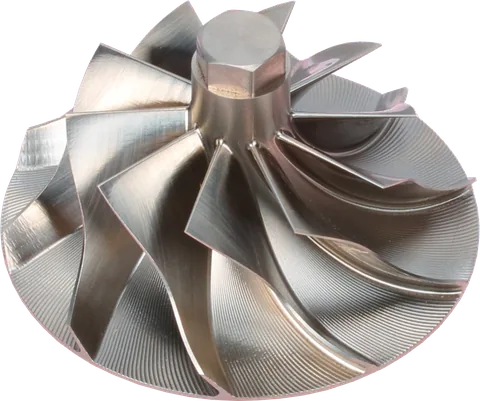
The compressor also has a limit. At low engine speed, the cylinders accept less airflow per second. Demanding high pressure from a large compressor at that low flow can move operation toward its surge boundary, where flow becomes unstable. This limits the usable operating range; black smoke alone does not prove that surge is occurring.
This explains low boost at low rpm under load on a poorly matched setup. However, low boost at idle is usually expected. Judge performance against the engine's specified load and speed conditions, not against a universal boost target.
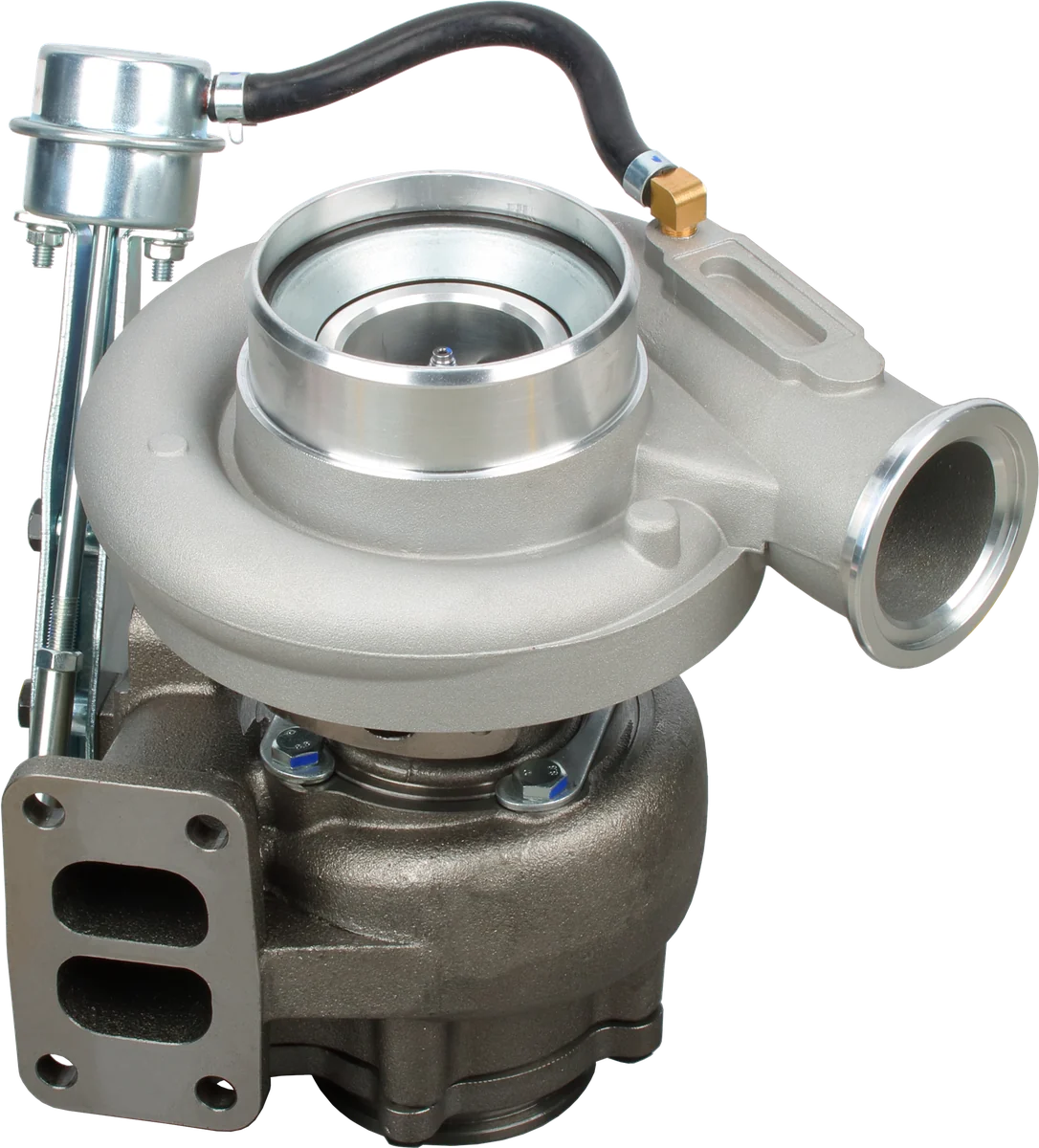
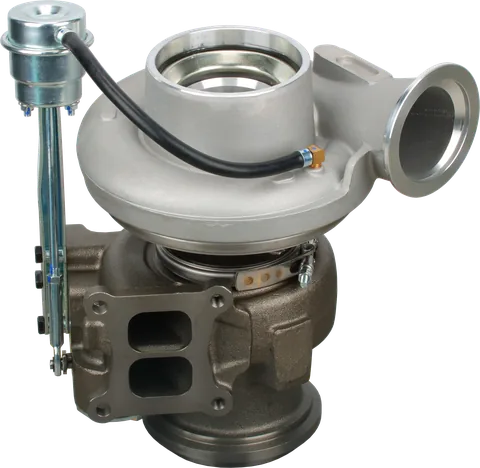
Compressor housing: guides the compressed air.
Turbine housing: guides exhaust gas to the turbine.
Actuator: check its type, linkage and calibration.
Product photograph from 2026. Numbers identify the features explained below.
Why smoke spikes when load changes
On a sudden pull-away or load application, fuel delivery can increase before the air system responds. The resulting turbo lag smoke reflects a temporary mismatch between fuel and usable oxygen. Several delays stack together:
- Extra combustion energy reaches the turbine only after exhaust leaves the cylinders.
- Exhaust manifold volume takes time to build pressure as gas flow increases.
- The rotating assembly needs energy and time to accelerate because it has inertia.
- Compressor airflow must raise pressure in the intercooler, pipes, and intake manifold while the engine keeps consuming air.
The smoke limiter controls this gap by restricting fuel according to measured or estimated air charge. An aggressive fuel ramp, an incorrect air-fuel ratio (AFR) calibration, or an overly optimistic air estimate can allow soot before boost catches up.
A generator can experience this at nearly constant speed when a large electrical load is applied. The air demand changes even though the operator never touches an accelerator.
How to diagnose turbocharger black smoke by its pattern
The timing of diesel smoke under load helps narrow the search. Record the pattern and whether the engine has a diesel particulate filter (DPF).
| Pattern | What it suggests | First direction |
|---|---|---|
| Brief puff that clears as rpm rises | Transient air shortage | Check whether behavior is new and whether fueling or hardware changed. |
| Smoke stays dense during a steady pull | Persistent air, fuel, or mixing problem | Test air delivery and fueling under load. |
| Smoke starts after a repair | Installation, fitment, or calibration issue | Review disturbed hoses, sensors, actuator setup, and part specification. |
| Visible soot at a DPF-equipped tailpipe | Possible filtration fault as well as excessive engine-out soot | Check DPF integrity and the engine's smoke-control operation. |
Faults that worsen low-speed turbocharger black smoke under load
Before blaming turbocharger size, look for a change in the installed system. A stock engine that previously pulled cleanly in the same conditions deserves a fault diagnosis.
| Fault | How it contributes | Useful clue |
|---|---|---|
| Dirty air filter or restricted inlet | Limits compressor inlet air. | Restriction indicator, collapsed hose, or debris in the inlet. |
| Boost leak | Compressed air escapes before reaching the cylinders. | Split boot, loose joint, hiss, or an oily dirt track. |
| Intercooler blockage | Internal restriction reduces delivered flow; packed external fins weaken cooling. | Excess pressure drop or elevated intake temperature under comparable conditions. |
| Stuck VGT or leaking wastegate | Vanes stuck too open or a wastegate held open weaken low-speed turbine drive. | Actual boost falls below requested boost during loading. |
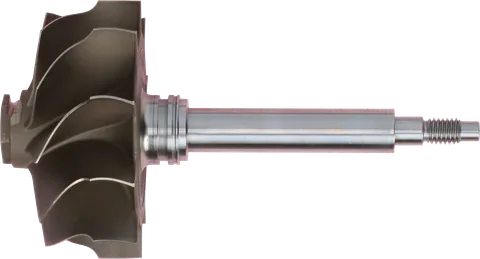
| Worn or damaged turbo | Wheel damage or bearing distress can reduce output. | Abnormal noise or physical damage after external faults are excluded. |
| Injector problem | Excess delivery or poor atomization creates rich pockets. | Roughness, uneven cylinder contribution, or abnormal injector test results. |
| Smoke limiter or sensor error | Fuel demand exceeds the air actually available. | Modified calibration or implausible pressure and airflow data. |
| Excess exhaust gas recirculation (EGR) | Recirculated exhaust displaces fresh air and oxygen. | Air mass and EGR response disagree with the commanded state. |
Boost pressure alone does not establish oxygen supply. Hot charge air or excessive EGR can leave less oxygen available even when the gauge looks familiar.
Diagnose turbo diesel black smoke in this order
Use the same operating conditions for each comparison. Free-revving in the yard rarely reproduces a low-speed, high-load air shortage.
-
Record the trigger. Note engine rpm, gear, load, temperature, and whether smoke ends as boost rises. Review recent filter service, injector work, turbo replacement, and tuning changes. Compare with previous behavior at a similar load, including altitude if the operating location changed. Avoid repeatedly lugging an engine to reproduce the fault; use a controlled load test within the manufacturer's operating limits.
-
Read codes before clearing anything. Save freeze-frame information and log requested versus actual boost, intake temperature, airflow where available, and boost-control position during the event. Check sensor plausibility before trusting the readings. Manifold absolute pressure includes atmospheric pressure; gauge boost does not. Comparing the two directly can create a false underboost diagnosis. Use application-specific targets instead of a borrowed boost number.
-
Check the inexpensive airflow restrictions. Inspect the filter and restriction indicator, inlet ducting, collapsed hoses, and intercooler fins. Confirm restriction using the service procedure; appearance alone cannot establish filter performance. Look for exhaust leaks ahead of the turbine, where escaping gas removes driving energy. Also consider downstream exhaust restriction when pressure data or relevant fault codes point there.
-
Test the charge-air path. Check boots, clamps, pipes, and the intercooler with the manufacturer's pressure-test method and limit. An oil stain suggests a place to inspect but does not prove a leak. If leakage is absent, investigate internal intercooler restriction and cooling performance under load. Compare pressure drop and charge temperature with the specified limits.
-
Verify control movement. Use the appropriate actuator test for VGT, wastegate, and any staging or bypass valves. Inspect wiring and pneumatic or vacuum supplies where fitted. A commanded position does not prove the mechanism moved correctly. Check EGR operation and fresh-air readings as part of the same assessment, particularly when boost appears reasonable but smoke remains.
-
Check fuel delivery and smoke control. Once the air system is verified, investigate injector performance using engine-specific tests. Review commanded fuel, cylinder contribution, and rail pressure where supported; no single reading proves an injector is healthy. Check that the software or mechanical boost-referenced fuel limiter matches the engine configuration. Correct an altered fuel ramp through the approved calibration process.
-
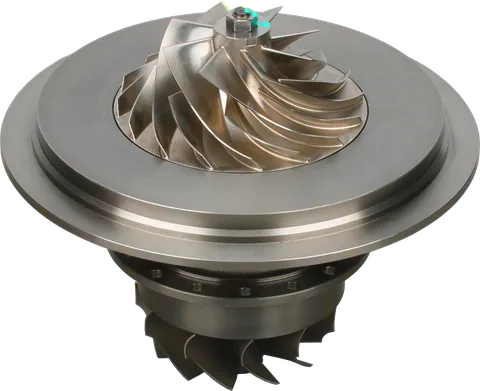
Assess the turbocharger with the evidence assembled. Inspect for wheel damage, rubbing, or bearing problems using the service procedure. Verify the installed unit and actuator calibration suit the application. Turbocharger replacement for black smoke is justified when testing identifies a turbo fault. If the problem remains unexplained, broaden the investigation to engine condition, valve timing, or excessive equipment load.
After repair, repeat the original test and confirm:
- Smoke returns to the engine's expected behavior.
- Boost and airflow follow the specified response.
- Power recovers without abnormal temperature or noise.
How OEM designs improve low-speed air supply
Manufacturers close this low-speed gap with smaller wastegated turbines, variable geometry, staged or electrically assisted systems, compact manifolds and lower rotor inertia. That is also why fitting a larger turbo can make pull-away smoke worse, and why the original system match should be preserved during repairs.
Common Questions
Is a brief puff of black smoke normal?
A brief puff can occur on older engines without a DPF, but a new or growing puff needs checking. Visible soot from a DPF-equipped engine should prompt diagnosis of both combustion and filtration.
Will downshifting help?
On a vehicle, downshifting within the recommended operating range can reduce torque demand per firing cycle and improve airflow. It may reduce lugging-related smoke, but it will not repair a leak or faulty injector.
Can injectors cause black smoke with normal turbocharger boost?
Yes. Excess fuel or poor spray quality can create soot despite apparently normal manifold pressure. Injector testing becomes important after checking fresh-air delivery, charge temperature, and EGR operation.
Should I increase boost to clear the smoke?
Do not adjust boost as a diagnostic shortcut. First establish whether air delivery, fuel control, or mixing is wrong. Extra boost can exceed the turbocharger's speed or the engine's pressure limits.
Does turbo diesel black smoke mean the turbocharger needs replacing?
No. Air restrictions, charge-air leaks, control faults, and injector problems can produce the same symptom. Replace the turbocharger when inspection and application-specific testing identify it as the failed component.
Is the turbocharger or injector causing black smoke?
Either can cause black smoke, so smoke alone does not identify the faulty part. Turbo damage can reduce output, while excess injector delivery or poor fuel spray can create soot. Check airflow restrictions, charge-air leaks, boost controls, and EGR operation first, then use engine-specific injector tests if the air system checks out.
For replacement guidance, contact LeadTurbo with your turbocharger part number, engine details, and the checks already completed.