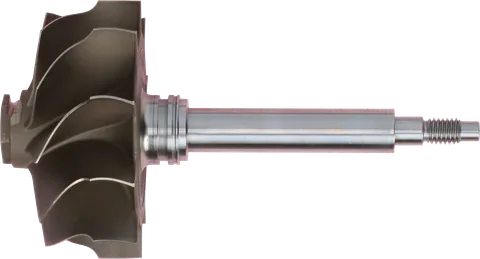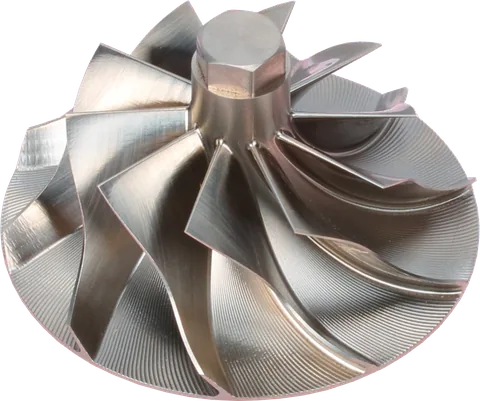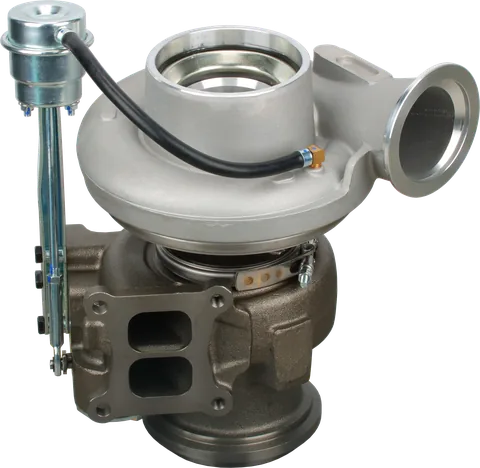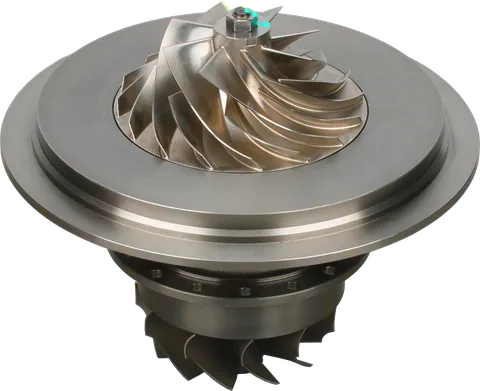
In a turbocharger, turbo oil whirl is an oil-film-driven orbit of the shaft that can remain controlled, while oil whip involves a potentially destructive rotor resonance.
Finding “oil whirl” in a teardown report can sound like a diagnosis of imminent failure. It is actually a description of motion. What matters is how large that motion becomes, whether the oil films maintain separation, and whether there is evidence of damage.
For an owner, a hum cannot answer those questions. For a shop, identifying the cause means connecting operating conditions, physical inspection, and—when necessary—specialist vibration measurements.
What the Oil Film Does Inside a Journal Bearing
A journal is the smooth section of shaft supported by a bearing. In a journal-bearing turbocharger, oil occupies the small clearance between the journal and the surrounding bearing surface.
As the shaft rotates, it drags oil into a narrowing gap. Pressure develops in this oil wedge and supports the shaft. The engine supplies fresh oil, but the shaft's motion generates the hydrodynamic pressure that carries the operating load.
The oil film also provides damping: it resists motion and dissipates some vibration energy as heat. Oil flowing through the bearing carries heat away.
The shaft does not have to sit exactly at the bearing's geometric center. Its position changes with load and with the pressure distributed around the film. Small movement is part of the bearing's operation; metal contact is not required for the shaft to move.
That distinction matters when inspecting a stopped turbo. Hand-felt radial movement without operating oil films does not directly describe the shaft's running behavior.
Why does turbo oil whirl occur below shaft speed?
To understand what causes turbocharger oil whirl, imagine marking the shaft's center in a cross-sectional view. The shaft spins around its own axis, but that marked center can also travel around a small path inside the bearing. That second movement is an orbit.
Oil-film pressure does more than push directly against displacement. Under some conditions, part of the force acts sideways, helping drive the orbit. If the film transfers enough rotational energy into this movement to overcome damping, self-excited whirl develops.
“Self-excited” means the bearing system sustains the motion without needing a repeating external push. An unbalanced wheel is therefore not required.
The orbit usually progresses in the same direction as shaft rotation, at a lower frequency. This is subsynchronous vibration: the orbit completes fewer cycles per second than the shaft completes revolutions.
For a simple stationary journal bearing, roughly half shaft speed or somewhat less is a familiar reference. It is not a universal diagnostic ratio for oil whirl in automotive turbochargers.
Also, shaft speed means turbocharger speed—not engine RPM. Comparing a recorded noise directly with the tachometer can produce misleading conclusions. See How Fast Does a Turbo Spin? for that distinction.
Floating Ring Bearings Have Two Oil Films
Many automotive journal-bearing turbos use fully floating bearing rings. Each ring sits between the shaft and the center housing, creating two lubricated clearances:
- Inner film: between the rotating shaft journal and the ring.
- Outer film: between the ring and the stationary housing.
Oil drag from the shaft turns the ring, while drag in the outer film resists that rotation. The ring settles at a speed below shaft speed, determined by the interaction of both films.
Ring speed is not a fixed percentage under all conditions. Clearances, oil viscosity, temperatures, and bearing geometry affect it.
The inner film therefore sits between two moving surfaces. The outer film sits between a rotating ring and a stationary housing. Each can contribute subsynchronous motion, and their behavior is coupled.
This explains why a fully floating turbo may show more than one subsynchronous vibration component. Inner-film behavior can also depart from the simple half-speed rule, including frequencies above half shaft speed.
Some designs restrain ring rotation while allowing other movement. Their behavior should not be interpreted using every assumption that applies to a fully floating ring. Our guide to how floating ring bearings work covers the arrangement in more detail.
Turbocharger Oil Whirl vs Oil Whip: How Imbalance Differs
These terms describe different mechanisms, even though they can appear together.
| Behavior | What drives it | Typical frequency behavior | Practical significance |
|---|---|---|---|
| Imbalance vibration | Uneven rotating mass creates a repeating force | Main excitation follows shaft rotation at one cycle per revolution | Requires attention to rotor condition and balancing |
| Oil whirl | Oil-film forces sustain an orbit | Below shaft frequency; often changes with operating speed | Can remain bounded within acceptable operating limits |
| Oil whip | Oil-film excitation couples strongly with a rotor natural mode | Frequency stays near that mode as shaft speed increases | Can produce large, damaging shaft motion |
A rotor natural frequency is a frequency at which the shaft-and-bearing system tends to vibrate when disturbed. The flexible shaft, rotating wheels, and bearing support all contribute.
Oil whip develops when the oil-driven motion locks onto a rotor mode, commonly a bending mode. Instead of continuing to rise as a fraction of shaft speed, its frequency remains near that mode over a speed range.
The oil film can keep feeding energy into that motion. Amplitude may grow until nonlinear effects or physical contact limit it. Bearing damage, journal scoring, wheel rub, or seizure can follow.
A frequency plateau alone is not proof of oil whip. Floating-ring systems can have complicated frequency changes, and measured sound also reflects the surrounding structure.

Horizontal axis: shaft speed.
Vertical axis: vibration frequency.
Oil whirl: a subsynchronous component can follow shaft speed.
Oil whip: the response can lock near a rotor mode.
Qualitative schematic, not measured test data or operating limits.
Why Production Turbos Can Live With Oil Whirl
Calling oil whirl an “instability” does not mean the shaft's orbit must grow without limit.
Bearing forces are nonlinear: their response changes as the shaft moves and the oil gap changes. A force relationship that describes tiny movements near one position does not describe the entire available clearance.
As motion develops, the changing film pressure and damping can establish a repeatable, bounded orbit. Engineers call this a limit cycle. The motion continues, but its amplitude stops growing.
Production turbochargers can operate with these bounded subsynchronous responses. Acceptable operation depends on sufficient oil-film separation, wheel clearance, and suitable vibration and noise levels across the intended operating range.
“Stable oil whirl” usually means this bounded operating state. It does not mean that every whirl-related sound is harmless, or that an orbit remains acceptable after wear changes the bearing geometry.
What Changes Turbo Bearing Instability?
There is no reliable rule that thicker oil, tighter clearance, or higher pressure always improves stability. The two films interact, and changing one condition can alter several parts of the response.
| Change | Why it matters | What a shop should consider |
|---|---|---|
| Bearing or journal wear | Changes clearance, surface condition, and pressure distribution | Measure journals, rings, and housing bores against applicable specifications |
| Incorrect clearance | Changes film stiffness, damping, flow, and ring behavior | Verify matched components and assembly dimensions |
| Oil temperature and viscosity | Change film resistance, heat transfer, and ring speed | Record whether symptoms occur cold, warm, or after sustained load |
| Oil supply pressure or restriction | Changes oil delivery and film operating conditions | Check supply at the specified location and conditions |
| Rotor imbalance | Adds synchronous forcing and changes the shaft's orbit and bearing loading | Inspect wheel damage, deposits, and rebuild history |
| Contamination or deposits | Can score surfaces, obstruct passages, or interfere with ring movement | Investigate oil cleanliness and the lubrication circuit |
Temperature deserves particular care. Cooler oil can make some whirl-related tones more noticeable, while excessive heat can reduce viscosity and compromise lubrication. A sound disappearing after warm-up does not by itself prove either a healthy or defective turbo.
Imbalance also has no simple one-direction effect on whirl amplitude. It changes the operating motion, sometimes substantially. Deliberately accepting imbalance is never a sensible way to control oil whirl. Read Turbocharger Balancing: Why Rebuilt Turbos Need It for the rebuilding implications.
Possible Turbocharger Oil Whirl Symptoms
A turbo hum noise, narrow-band whine, or tone that appears within a particular load range may prompt an investigation. Some bearing-related sounds change noticeably with oil temperature or appear to hold a similar pitch while operating conditions change.
However, intake leaks, exhaust leaks, wheel damage, airflow noise, and other rotating components can create overlapping symptoms. Phone audio cannot establish the underlying shaft motion.
Useful observations include:
- Whether the sound is new or becoming louder.
- Whether it occurs cold, fully warm, or after a long pull.
- Whether it appears during acceleration, steady load, or lift-off.
- Whether it accompanies reduced boost, smoke, or increased oil consumption.
- Whether it began after an oil change, turbo rebuild, or lubrication-system repair.
Smoke and oil consumption are not specific evidence of oil whirl. They need their own diagnosis. If noise suddenly becomes grinding or scraping, especially with smoke or power loss, stop operating the vehicle and arrange inspection.
For broader noise causes, start with Why Does My Turbo Whine?.
How to Diagnose Turbocharger Oil Whirl
A general repair shop can identify many conditions that affect bearing behavior without claiming to measure oil whirl directly.
- Confirm the assembly. Identify the turbo part number, bearing design, and any previous rebuild or modification.
- Verify lubrication. Check oil level, approved specification, contamination, feed-line condition, and relevant pressure requirements.
- Inspect drainage and ventilation. Check the oil return and crankcase ventilation when leakage or smoke is present.
- Rule out other noise sources. Inspect intake connections, exhaust joints, brackets, and nearby accessories.
- Inspect the rotor while stopped. Look for wheel damage, rub marks, rough rotation, and shaft movement measured using the specified procedure.
- Measure during teardown. Examine journal condition, ring dimensions, housing bores, oil passages, and evidence of heat or scoring.
Scoring can establish that contact occurred; it rarely proves oil whip by itself. Likewise, excessive clearance establishes a dimensional problem without identifying every vibration mechanism that preceded it.
Confirming subsynchronous motion generally requires suitable sensors, a reliable shaft-speed reference, and frequency analysis across operating conditions. Direct orbit measurement may require specialized test equipment.
A specialist can distinguish a component that follows shaft speed from one that remains near a rotor mode. Engine RPM and a single audio recording are insufficient substitutes. Our turbocharger diagnosis guide provides a broader inspection sequence.
Why Thicker Oil Is Not a Repair
Changing viscosity changes the bearing system. It may change a tone without correcting wear, contamination, poor oil delivery, or damaged rotating parts.
Thicker oil affects drag in both films, ring speed, flow through restrictions, and heat removal. It can also affect oil delivery during cold starts—particularly relevant to Canadian winter operation.
Use the engine manufacturer's approved oil specification and viscosity guidance for the application and ambient conditions. Do not add an unapproved viscosity modifier or install an oil restrictor simply to quiet a suspected whirl noise.
If dimensions are outside specification, choose the repair based on measured condition. The choice between a rebuild, replacement core, and complete assembly is explained in CHRA vs. Complete Turbocharger.
Common Questions
Does turbo oil whirl mean the turbo is failing?
No. A bounded oil whirl orbit can occur in a healthy journal-bearing turbo. Damage becomes a concern when motion compromises oil-film separation or causes contact. A new noise needs investigation, but the term alone does not establish failure.
Can a perfectly balanced turbo develop oil whirl?
Yes. Oil whirl draws energy from rotation through the bearing oil film, so imbalance is not required. Correct balancing still matters because imbalance adds vibration and changes bearing loads.
Is oil whirl always at half the shaft speed?
No. Roughly half speed or less is a useful reference for a simple stationary journal bearing. Fully floating rings introduce another rotating surface and a second oil film, so actual frequencies can differ, including inner-film motion above half shaft speed.
Can I identify oil whip from a constant turbo hum?
No. A steady tone can have several causes, including other bearing responses, airflow noise, and structural resonance. Identifying oil whip requires evidence of vibration locking onto a rotor mode, supported by speed-related measurements and specialist interpretation.
Will thicker oil stop turbo oil whirl?
It might change the sound or vibration, but that does not establish a repair. Viscosity affects both bearing films, ring speed, oil flow, and heat removal. Use the engine manufacturer's approved oil specification and diagnose the underlying condition.
Can a repair kit fix oil whirl?
Only if inspection identifies a serviceable assembly and a bearing-related fault the correct kit can address. A kit cannot restore worn shaft journals or damaged housing bores. Rebuilding also requires appropriate measurements, assembly procedures, and balancing.
Does oil whirl require turbocharger replacement?
Not necessarily. A bounded oil whirl orbit can occur in a healthy journal-bearing turbo. If dimensions are outside specification, choose the repair based on measured condition.
Need help identifying replacement options? Contact LeadTurbo with your turbo part number, vehicle details, symptoms, and any inspection findings.