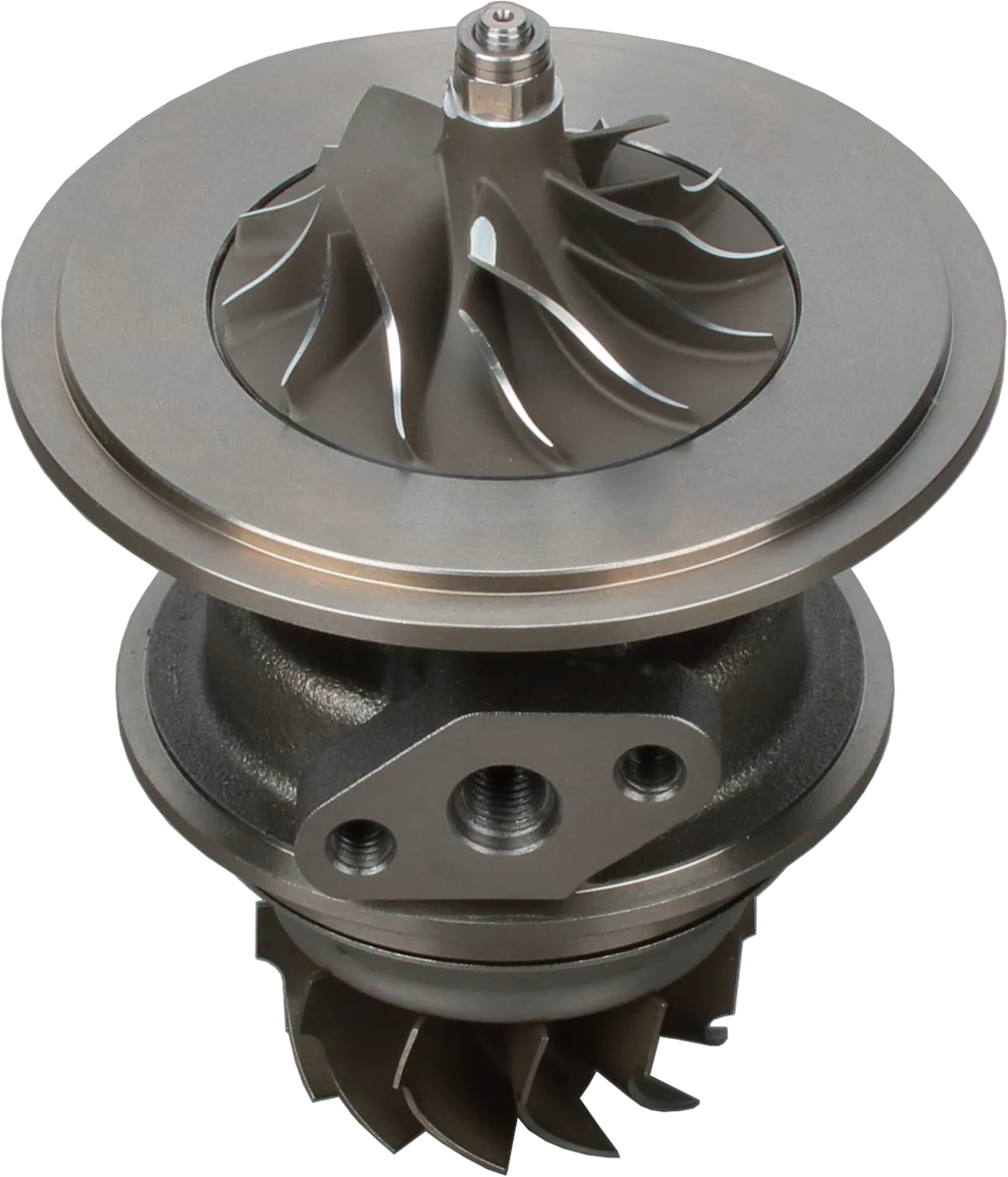
You remove the intake pipe, gently move the compressor nut, and feel the wheel shift. That can be unsettling, especially if you are already investigating smoke or a new whistle.
The useful question is not simply whether the shaft moves. It is which direction it moves, how that movement was measured, and whether there is evidence of contact or wear. There is no universal acceptable turbo shaft play number.
Why a stopped journal-bearing turbo can feel loose
A journal-bearing turbo needs clearance between its bearing surfaces so oil can flow through them. In a floating-ring arrangement, there are two relevant spaces:
- An inner clearance between the shaft journal and the bearing ring.
- An outer clearance between the bearing ring and the center housing.
When you move the stopped shaft sideways, movement within both clearances can contribute to what you feel. The shaft can also tilt, making movement at the compressor end more noticeable than movement at a bearing journal.
During operation, rotation draws oil through the bearing clearances and develops supporting hydrodynamic pressure. The oil films also help damp rotor motion.
At rest, that operating oil-film support is absent. Residual oil may still coat the parts; the bearing is not necessarily dry. However, it is not supporting the rotor in the same way it does while running.
This explains why some radial looseness can be normal. It does not mean that any amount of movement will become acceptable once oil pressure builds. Worn journals, damaged rings, or enlarged housing bores still need attention.
Our guide to how floating-ring bearings work in a turbocharger explains the arrangement in more detail.
Turbocharger radial vs axial play: what each tells you
Keep the two directions separate. Pulling sideways and outward together produces an ambiguous result.
| Type of movement | Direction | What it mainly checks in a journal-bearing turbo | What deserves investigation |
|---|---|---|---|
| Radial play | Across the shaft axis: up/down or side-to-side | Journal bearings, shaft journals, and bearing housing clearances | Excessive measured travel, uneven movement, or wheel contact |
| Axial play, also called end float | Along the shaft axis: toward the compressor or turbine | Thrust bearing and associated thrust surfaces | Excessive measured end float or evidence of axial rubbing |
| Apparent wheel wobble | Wheel appears to tilt or run unevenly | May involve clearance, shaft damage, wheel damage, or measurement technique | Visible irregularity during gentle rotation or inconsistent readings |
Turbo radial play primarily concerns radial support; turbo axial play primarily concerns thrust control. Neither measurement identifies the failed component by itself.
The thrust system controls movement caused by forces acting along the shaft. Excessive end float can involve the thrust bearing, thrust collar, or other mating surfaces. See turbo thrust bearing failure: causes and signs.
“Wheel wobble” is less precise. Movement created by pushing a stationary wheel sideways is different from a wheel that appears to run crooked while rotating. Report exactly what you observed.
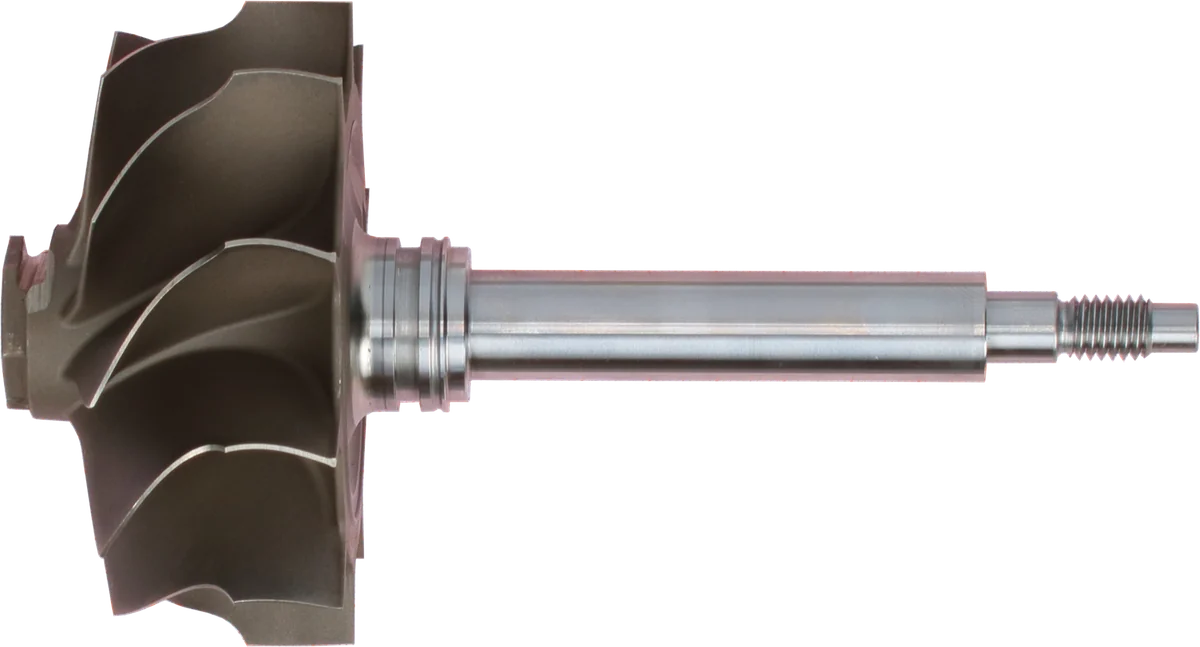
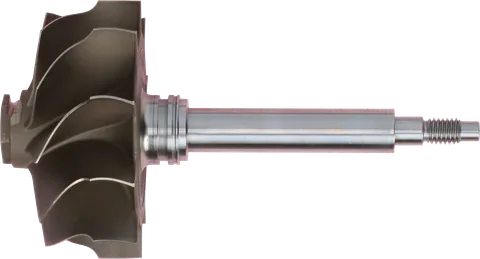
Turbine wheel: exhaust energy drives the shaft.
Shaft surface: inspect wear and scoring before reuse.
Shaft end: connects to the compressor-side rotating parts.
Radial motion: perpendicular to the shaft axis.
Axial motion: along the shaft axis. Arrows show direction, not allowable clearance.
Product photograph from 2026. Numbers identify the features explained below.
Check for damage before taking measurements
Work with the engine cold and prevent it from starting. Follow the vehicle's service instructions for access, and keep dirt, hardware, and cleaning debris out of the intake.
Use a light to inspect the accessible wheel and housing:
- Look for fresh shiny arcs, scraped surfaces, or grooves around the wheel.
- Check blade tips for damage and uneven edges.
- Gently turn the rotor by hand without forcing it sideways.
- Note binding, scraping, grinding, or a repeatable tight spot.
- Look for pooled oil, wet deposits, and evidence of recent leakage.
- Inspect the turbine side when safely accessible; a clean compressor side does not clear the entire assembly.
Do not loosen the compressor nut, pry against blades, or use compressed air to spin the turbo. Free-spinning time is not a reliable bearing test.
Wheel contact under a gentle inspection load is a red flag that needs assessment under the manufacturer's procedure. Do not force the wheel into the housing to “find the limit,” or assume oil pressure will make visible rub damage harmless.
How to measure turbo shaft play correctly
A fingertip check can identify a concern. It cannot establish whether a turbo passes its service limits.
Use a dial indicator with suitable resolution, a rigid mounting arrangement, and the procedure for the exact turbocharger. If access prevents the specified setup, removal or specialist inspection may be necessary.
Start with the correct specification
When checking diesel turbocharger shaft play, identify the turbo by its identification plate or part number, not just the vehicle's engine size. Different turbochargers fitted to similar vehicles can have different bearing arrangements and limits.
Confirm:
- Whether the specification applies to a new assembly or an in-service unit.
- The required indicator contact point and measuring direction.
- Whether the stated value is total travel, a one-sided clearance, or a component dimension.
- The required lubrication condition and test force, if specified.
- Whether measurements are required at the compressor end, turbine end, or both.
A published bearing clearance is not automatically an allowable reading at the compressor nut. Shaft overhang and tilting can change that reading. Our turbocharger part-number identification guide can help establish which unit you have.
How to measure turbocharger radial play
Mount the indicator securely relative to the turbo housing. Place its tip on the manufacturer's designated measuring surface, with the indicator's measuring direction perpendicular to the shaft axis.
Apply gentle transverse force in one direction, then in the opposite direction. Record the full indicator travel between those positions. Keep axial force out of the measurement.
Follow the specified arrangement for applying force at the compressor and turbine ends. Moving both ends together and rocking them in opposite directions create different motions; their readings are not interchangeable.
Check the required radial directions and both ends where the procedure calls for them. Record the measuring location with each result. Do not compare a compressor-end reading with a turbine-end limit.
If the service information does not define the setup, do not create a pass/fail limit from an improvised test.
Measure axial movement along the shaft
Reposition the indicator so its measuring direction is parallel to the shaft axis, contacting the specified end surface or fixture.
Gently move the rotor toward the turbine, then toward the compressor. Record total end-to-end travel. Push and pull straight along the axis without adding sideways pressure or tilting the assembly.
Use the designated load points, with access to both sides as required. Do not pull on blade edges or turn the retaining nut with a tool.
Repeat readings to confirm consistency. A moving indicator base, angled contact, or inconsistent hand force can produce misleading results. Shaft rotation and runout checks are separate procedures from this stationary clearance measurement.
Which turbocharger shaft play symptoms matter most?
The strongest case for a damaged turbo combines measured excessive clearance with physical evidence or operating symptoms.
Wheel contact, rub marks, binding, and grinding deserve immediate attention. Stop the inspection if rotation requires force. Running the engine to “see if it clears up” can worsen damage.
Oil wetness needs context. An oily compressor inlet can reflect oil carried through the crankcase ventilation system. Leakage can also involve a restricted drain, crankcase pressure, or other conditions beyond bearing wear.
However, substantial oil wetness together with excessive measured play, smoke, or wheel contact makes further operation a poor diagnostic choice. Trace the cause before fitting replacement parts. The turbocharger oil-leak causes guide covers the surrounding checks.
Noise is supporting evidence, not a clearance gauge. Air leaks, wheel damage, imbalance, and bearing behavior can produce different sounds. A hand check cannot diagnose oil whirl or predict how a rotor behaves at operating speed.
For a broader inspection sequence, use how to diagnose a failed turbocharger before replacement.
Ball-bearing turbos need their own criteria
A ball-bearing turbo supports its rotor through rolling elements and races rather than the same journal-bearing arrangement described above. Cartridge construction, internal clearance, preload, and mounting design affect what you feel.
Some designs also use oil damping around the bearing cartridge. Therefore, “ball bearing means absolutely no movement” is not a safe universal rule.
Do not apply journal-bearing hand-check expectations or service limits to a ball-bearing unit. Identify the cartridge type and follow its manufacturer's instructions. Rough rotation, contact, or abnormal measured movement still warrants inspection.
The ball-bearing versus journal-bearing turbo guide explains the practical differences.
Decision guide: leave it, measure it, or repair it?
| What you find | Practical next step |
|---|---|
| Some radial movement by hand, smooth rotation, no visible contact | Obtain the correct specification and measure before condemning the turbo. |
| Repeatable measurements within limits, no physical damage | Continue diagnosing any smoke, noise, or boost complaint; clearance alone does not clear the turbo. |
| No reliable specification or no access for the required measurement | Have a qualified turbo shop identify and inspect the assembly. |
| Radial or axial movement outside the applicable service limit | Remove from service and assess the shaft, bearings, thrust parts, and housing. |
| Contact, fresh rub marks, binding, grinding, or damaged blades | Stop operating the engine until the turbo and related damage are assessed. |
| Excessive play with substantial oil leakage or smoke | Investigate the bearing assembly and the engine's oil supply, drain, and ventilation system. |
Repair choice depends on what remains serviceable. A bearing kit cannot correct an undersized shaft journal, a damaged bearing bore, or a wheel that has rubbed away material.
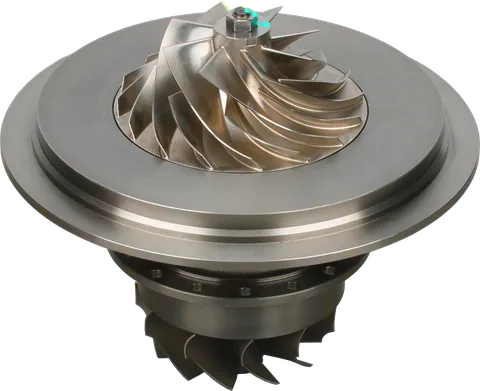
Compare CHRA versus complete turbocharger replacement after the inspection. Correct the original cause of damage before installing either option.
Common Questions
Should a new turbo have any shaft play?
A new journal-bearing turbo may have noticeable radial movement while stopped. Axial clearance also exists but needs measurement. Acceptability depends on the exact turbo's specifications and inspection procedure, not whether it feels completely tight.
Is any axial play acceptable?
Yes, a journal-bearing thrust system needs operating clearance. However, obvious in-and-out movement deserves investigation. Measure total axial travel using the specified procedure and compare it with the manufacturer's limit.
Can I check turbo shaft play without removing the turbo?
You can often inspect the compressor side after removing the inlet duct with the engine cold and disabled. A complete measurement may require removal to access the turbine side and mount the indicator correctly.
Does adding oil make shaft play disappear?
Added oil may change how movement feels, but it does not recreate the rotating bearing's operating conditions. It cannot prove that clearances are acceptable or repair worn surfaces.
Does normal shaft play mean the turbo is healthy?
No. Acceptable static clearance does not rule out wheel damage, imbalance, oil restriction, boost-control faults, or problems that appear only during operation. Use shaft measurements as one part of the diagnosis.
Can a repair kit fix excessive shaft play?
Only if inspection confirms that the reusable parts remain within specification. New bearings cannot restore a worn shaft journal or damaged housing bore. A proper rebuild also requires suitable balancing and verification.
How much turbocharger shaft play is normal?
There is no universal limit; some side-to-side movement can be normal in a stopped journal-bearing turbo. Measure radial and axial movement using the exact turbocharger's specified procedure and compare the readings with the manufacturer's limits. A fingertip check alone cannot confirm acceptable clearance, and wheel contact or binding needs investigation.
Does turbocharger shaft play require replacement?
Not necessarily. Measure clearance using the manufacturer's procedure, compare it with the service limits, and inspect for damage. If play exceeds those limits, remove the turbo from service for assessment. Repair or replacement depends on what remains serviceable; new bearings cannot restore a worn shaft journal or damaged housing bore.
Need help choosing parts after checking turbo shaft play? Contact LeadTurbo with your turbo part number, symptoms, and any measured clearances.