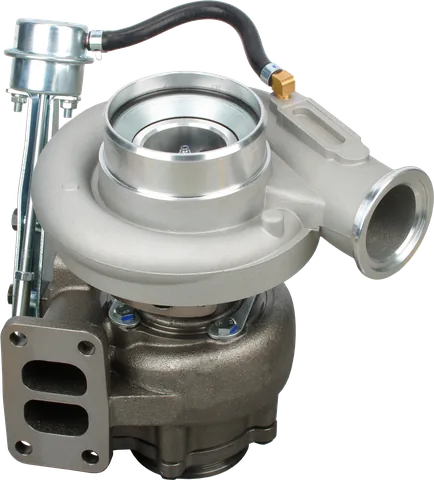
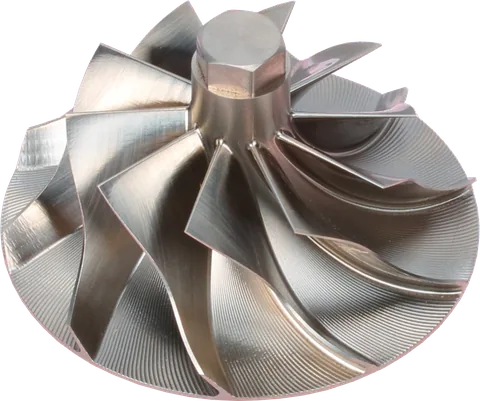
For a stock pickup turbocharger replacement, the correct original-equipment specification is usually the strongest starting point, just as it is for stock work trucks and passenger vehicles. For a performance build, reduced bearing losses may justify a ball bearing assembly—but only within a turbocharger properly matched to the engine.
The useful ball bearing vs journal bearing turbo comparison starts with the complete installation. A bearing upgrade cannot compensate for an oversized turbine, a restricted oil drain, or incorrect boost control.
How Do Turbocharger Bearings Work?
A turbocharger’s shaft connects the exhaust-driven turbine to the compressor. Its bearing system must support sideways loads and control end-to-end movement while operating at high speed and temperature.
A journal bearing turbo supports the rotating shaft on oil films. Oil enters under pressure, while shaft rotation creates the hydrodynamic pressure that carries the load. During normal operation, adequate oil films separate the working surfaces.
Many automotive designs use floating rings with oil between the shaft and ring and between the ring and housing. The ring can rotate more slowly than the shaft. Other designs use different bearing arrangements, so “journal bearing” does not describe one universal construction. A separate thrust bearing commonly handles axial loads.
Our guide to how floating ring bearings work explains that arrangement in more detail.
A ball bearing turbo uses rolling elements between inner and outer races. Angular-contact bearing arrangements can support both radial and axial loads. These bearings are often packaged in a cartridge within the center housing.
The balls reduce the dependence on sliding oil-film support at the shaft, but rolling contact still needs lubrication. Ball bearings are neither frictionless nor immune to wear.
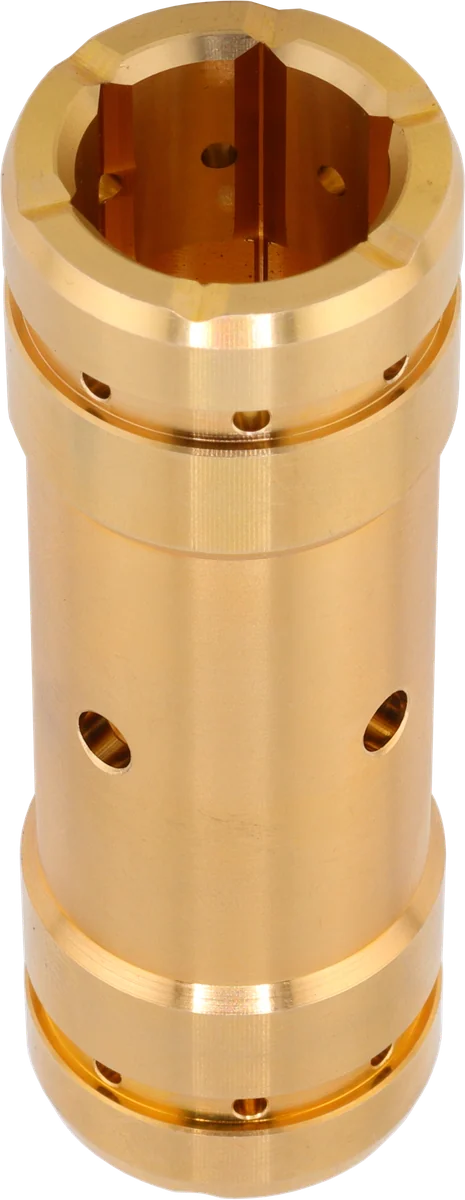
Bearing bore: the inner oil film supports the shaft.
Oil passages: keep the lubrication path clear.
Outer bearing surface: inspect the fit and condition.
Product photograph from 2026. Numbers identify the features explained below.
Comparing ball bearing vs journal bearing turbo designs at a glance
| Consideration | Journal bearing turbo | Ball bearing turbo |
|---|---|---|
| Shaft support | Hydrodynamic oil films | Balls running between bearing races |
| Friction losses | Oil shearing consumes energy | Often lower bearing losses in comparable designs |
| Transient response | Depends heavily on the complete turbo match | Can accelerate more readily after a load change |
| Vibration damping | Oil films provide damping, with possible instability under some conditions | Rolling contacts provide little damping; an external oil damper is often used |
| Lubrication | Correct flow, pressure, viscosity, and cleanliness are essential | Equally dependent on correct oil delivery; metering may differ |
| Purchase cost | Often lower | Often higher |
| Repair options | Many designs have service parts available | Cartridge or CHRA replacement may be necessary |
| Noise mechanisms | Oil-film motion can create subsynchronous vibration | Defects can generate characteristic rolling-element frequencies |
| Stock replacement | Appropriate when it matches the OE specification | Appropriate when it matches the OE specification |
These are design tendencies, not guarantees about every product.
Friction Losses and Turbo Spool Response
The turbine must provide enough torque to drive the compressor, overcome mechanical losses, and accelerate the rotating assembly. Reducing bearing losses leaves more torque available for acceleration.
That is why ball bearings can improve turbo spool response, especially during changing operating conditions. A driver may notice more immediate boost recovery after shifting or reapplying the throttle.
However, transient response and boost threshold are different. Transient response describes how quickly the turbo reacts to a change. Boost threshold describes the operating conditions at which sufficient exhaust energy becomes available to build useful boost. Lower bearing friction does not erase that energy requirement.
When comparing journal bearing vs ball bearing turbocharger designs, consider:
- Compressor and turbine wheel dimensions and mass.
- Turbine housing size and exhaust-flow capacity.
- Engine displacement, operating speed, and load.
- Wastegate or variable-geometry control.
- The boost target and how response was measured.
A small journal bearing unit may respond faster than a substantially larger ball bearing unit. Likewise, changing wheel design and housing size while changing bearings makes it difficult to attribute the result to bearings alone.
Ask for comparisons under equivalent conditions. An unloaded free-spin demonstration does not establish on-engine performance.
Why Ball Bearing Cartridges Still Need Oil Damping
Rolling-element bearings can locate the shaft accurately, but their contacts provide little inherent damping. Damping dissipates vibration energy and limits rotor movement, particularly as the assembly passes through resonant conditions.
Many turbocharger ball bearing cartridges therefore use a squeeze-film damper. A controlled oil-filled clearance surrounds the cartridge or its supporting sleeve. Small sideways movements squeeze oil through that clearance, resisting motion and absorbing energy.
The cartridge support is typically restrained from rotating with the shaft. Its surrounding oil film performs a different job from the load-carrying film immediately around a journal-bearing shaft.
This distinction matters when buying parts. Cartridge support dimensions, oil passages, and housing condition affect the assembly’s behavior. A ball bearing cartridge is not automatically a drop-in conversion for a journal bearing center housing.
It also explains why “ball bearing” does not mean that oil pressure, oil viscosity, or housing wear becomes unimportant.
Oil Requirements and Contamination Sensitivity
Turbocharger bearing oil requirements vary, but both systems need clean oil delivered according to the engine and turbocharger specifications.
In a journal bearing system, inadequate supply or unsuitable viscosity can compromise the separating oil film. Contaminants can score journals and bearing surfaces, while deposits can obstruct passages.
In a ball bearing system, particles passing through concentrated rolling contacts can damage the balls or races. Surface damage may develop into fatigue and increasing vibration. Ceramic balls do not make contaminated oil harmless.
Some ball bearing turbos require less oil flow than comparable journal bearing designs, but less flow does not mean any lower pressure is acceptable. Required pressure, flow, and metering depend on the specific assembly.
Before installation:
- Confirm the specified engine oil grade and performance standard.
- Inspect the feed line for restrictions, deposits, and damage.
- Check oil pressure using the specified location and procedure.
- Verify whether oil metering is built in or requires a specified external component.
- Confirm that the drain is unobstructed and correctly routed.
- Check crankcase ventilation and follow the prescribed priming procedure.
- Connect the cooling circuit where the turbo requires one.
Do not add a generic restrictor simply because the replacement uses ball bearings. Equally, do not assume the original feed arrangement suits a conversion.
Oil escaping from a turbo can also involve drain restrictions or crankcase pressure. Review turbocharger oil leak causes before treating leakage as proof of failed bearings.
Ceramic Balls, Durability, and Repair Costs
A ceramic ball bearing turbo commonly uses a hybrid bearing: ceramic balls running against steel races. Compared with steel balls of the same dimensions, ceramic balls have lower mass, which can benefit high-speed bearing operation.
The label does not establish the quality of the races, cage, lubrication system, assembly, or rotor balance. It also does not mean that every bearing component is ceramic.
Neither bearing type has an automatic service-life advantage across all applications. Contamination, oil starvation, excessive temperature, overspeed, imbalance, and abnormal thrust loads can damage either system.
Journal bearing turbos often offer a lower purchase price and broader repair-part availability. However, installing a repair kit is only appropriate when the shaft, housing, and other reusable components remain within specification. New bearings cannot restore a damaged journal.
Ball bearing repairs may require a specialist cartridge or complete center housing rotating assembly, commonly called a CHRA. Availability varies, so check the repair route before paying for an upgrade.
Compare the total cost of the turbo, plumbing changes, calibration, and future servicing. Our CHRA vs. complete turbocharger guide helps distinguish those replacement options.
Noise: Bearing Defects Versus Oil Whirl
Neither design is inherently silent, and a whistle alone cannot identify the bearing system.
With ball bearings, damage to a race, ball, or cage can generate repeated disturbances at characteristic frequencies. Those frequencies depend on bearing geometry and shaft speed; they do not all match one revolution of the shaft. Some components may occur above shaft rotational frequency, while cage-related motion can occur below it.
In journal bearings, oil-film forces can excite sideways orbital motion of the rotor. This is called oil whirl and is typically subsynchronous—below shaft rotational frequency, often around half that frequency or less. Floating-ring arrangements can produce more complicated behavior.
Under some conditions, the motion can couple to a rotor bending mode and develop into oil whip. Its frequency may then remain near that mode as shaft speed increases. A tonal sound can result, although oil-film vibration is not automatically evidence of destructive instability.
Ball bearings avoid the journal’s inner oil-film whirl mechanism, but their dampers and supporting structure can still contribute to vibration.
For either type, distinguish these mechanisms from imbalance, airflow noise, leaks, and wheel contact. A phone recording cannot reliably make that distinction. See why your turbo may whine for practical diagnostic checks.
Choosing for Stock Replacement or Performance
For OE applications, replace like-for-like unless you are undertaking an engineered change with appropriate calibration and validation. Match the approved turbo specification, not simply its mounting flange or advertised bearing type.
That includes wheel configuration, housings, actuator, wastegate or variable-geometry mechanism, and oil and coolant connections. Calibration alone cannot correct incompatible hardware.
For a performance build, ball bearings may be worthwhile when transient response matters and the supporting changes fit the budget. A correctly sized journal bearing turbo remains a valid performance choice, particularly when purchase cost and serviceability matter.
Before ordering:
- Record the original turbo part number and engine application.
- Identify why the previous turbo failed.
- Confirm the replacement’s lubrication and cooling requirements.
- Check actuator compatibility and calibration needs.
- Ask whether the assembly is serviceable and what replacement parts are available.
Use the turbo fitment verification guide to check those details before committing.
Common Questions
Does a ball bearing turbo always spool faster?
Lower bearing losses can improve response when comparable turbos are tested under the same conditions. Wheel size, turbine housing, exhaust energy, and boost control still matter. A larger ball bearing turbo can respond more slowly than a smaller journal bearing turbo.
Is a ceramic ball bearing turbo oil-free?
No. Ceramic usually describes the balls in a hybrid bearing with steel races. The turbo still needs the specified oil supply for lubrication and heat management, and its cartridge may also rely on oil for vibration damping.
Do all ball bearing turbos need an oil restrictor?
No universal restrictor rule applies. Follow the instructions for the exact turbo and verify the required inlet pressure and oil supply arrangement. Some designs have built-in metering. Adding another restriction can starve the bearing system.
Are journal bearing turbos easier to rebuild?
Often, provided suitable parts, specifications, and specialist services are available. Replacing bearings alone does not correct worn journals, damaged housings, or rotor imbalance. Some ball bearing assemblies require cartridge replacement instead of individual bearing repairs.
Can turbocharger noise identify bearing type or failure?
Not reliably. Air leaks, wheel damage, imbalance, bearing defects, and oil-film motion can produce overlapping sounds. Diagnosis needs operating conditions and mechanical checks; distinguishing bearing frequencies generally requires vibration measurements and shaft-speed information.
Should I convert a stock turbocharger to ball bearings?
For an OE replacement, replace like-for-like unless the change is part of an engineered upgrade with appropriate calibration and validation. Bearing type alone does not establish compatibility with the engine, oil system, actuator, or boost-control strategy.
Need help with your ball bearing vs journal bearing turbo choice? Contact LeadTurbo with your turbo part number, vehicle details, and symptoms.