A Detroit Series 60 turbo problem often becomes noticeable under load: the truck pulls poorly, smoke increases, or a familiar whistle changes. Those symptoms deserve investigation, but they do not automatically condemn the turbocharger. A split charge-air boot or restricted oil drain can create symptoms that resemble internal failure.
The Series 60 is an inline-six, four-stroke diesel engine family widely associated with heavy trucks. Its turbocharger uses exhaust energy to drive a compressor, supplying more air for combustion. On a hard-working diesel, reliable airflow and lubrication matter to pulling performance, combustion quality, and component life.
Successful Series 60 turbo replacement starts with two checks: identify the exact assembly and determine why the existing unit failed.
Identify the installed Detroit Series 60 turbo
LeadTurbo’s catalog includes S400S061, S400S062, K31, GT4294JNS, GT4708BJNS, GTA4202, GTA4294, and GTA4502V complete turbocharger listings. It also includes an S410SX turbine housing listing referencing Detroit Diesel S60.
A search for “GT4294 turbo” or “S400 turbo Detroit” can help locate candidates, but those terms are not sufficient fitment information. Likewise, “Series 60 turbocharger” describes an application family rather than one interchangeable assembly.
For Series 60 turbocharger identification, look for a data plate, label, or stamped identification area, commonly on the compressor housing; the location varies by assembly. Clean it gently and photograph every line. Record complete numbers, spaces, and suffixes. A casting number on a housing may identify that casting without identifying the complete turbo.
The turbo model describes a design family. An OE part number identifies a particular original-equipment service part, while a turbo assembly number identifies a specific turbo configuration. Catalog numbers may serve as replacement references, so confirm what each number represents.
Record the engine identification as supporting information. Photograph the mounting flange, compressor outlet, exhaust connection, oil connections, and any actuator. If the tag is missing, use those details to support identification rather than ordering by appearance.
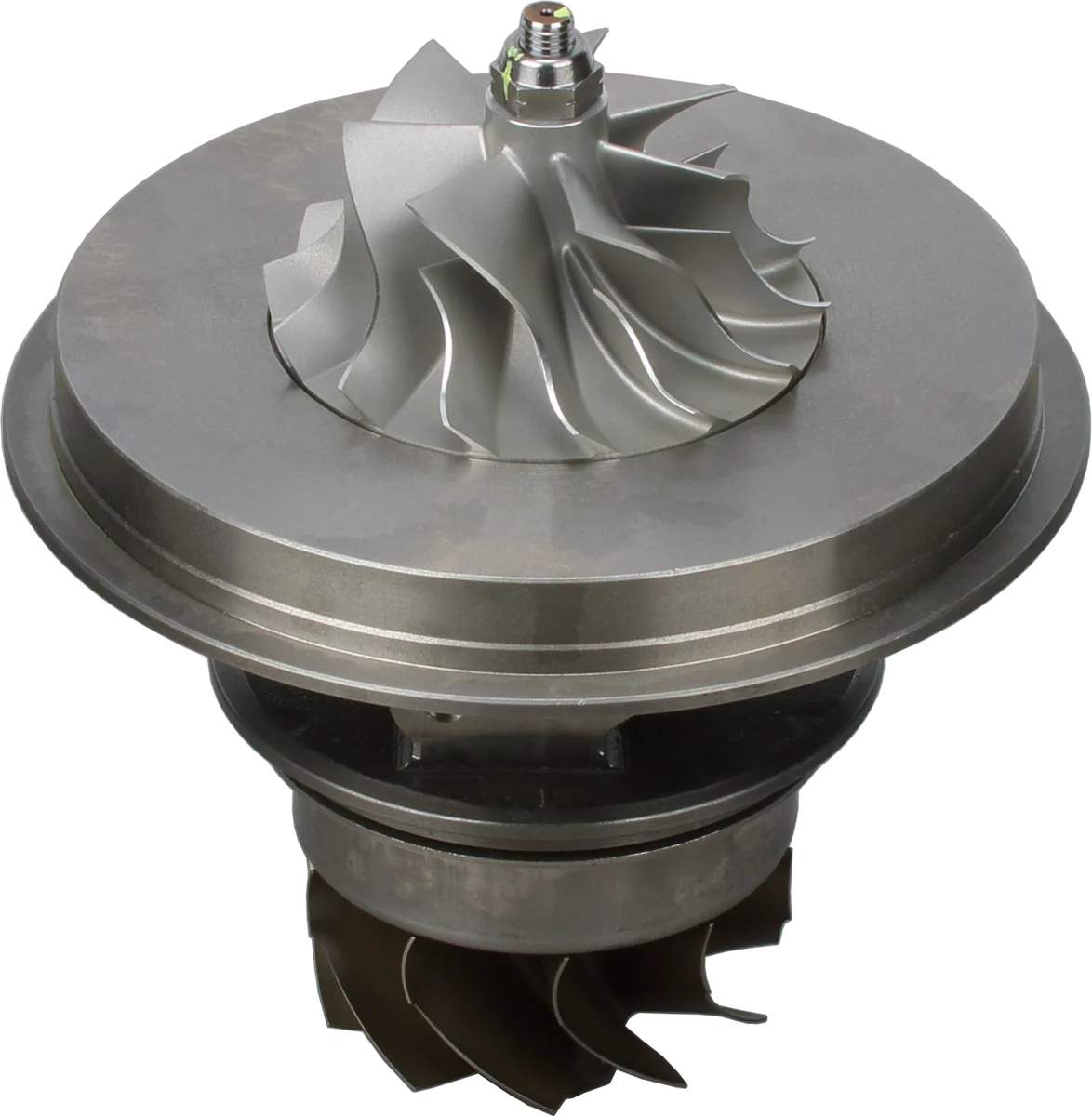
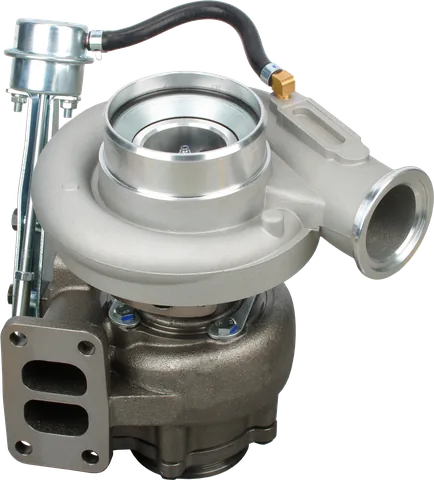
Compressor wheel: transfers shaft power to the air.
Bearing housing: supports the lubricated rotating assembly.
Turbine wheel: exhaust energy drives the shaft.
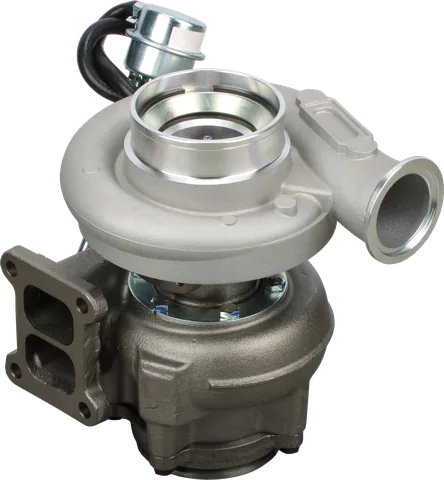
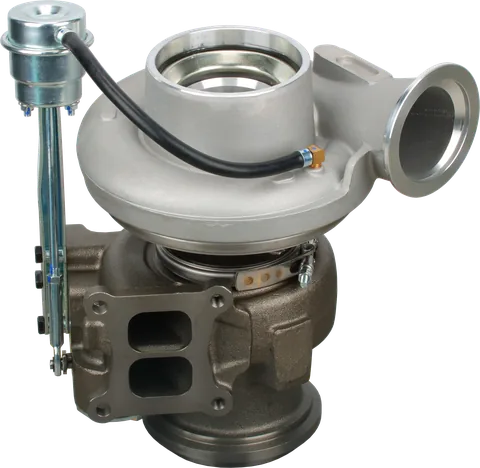
Product photograph from 2026. Numbers identify the features explained below.
Representative Catalog Examples
These are examples to verify against the installed turbo data plate and OE part number, not an interchange chart. Applications below reproduce catalog listing wording. Shorthand such as “6L” or “6L60” should not be treated as a verified displacement specification.
| Part number | Turbo model | Product type | Application as listed |
|---|---|---|---|
| 171701 | S400S061 | Complete turbocharger | Detroit Diesel S60 470HP |
| 171702 | S400S062 | Complete turbocharger | Detroit Diesel S60 6L 470HP |
| 172743 K31 3971QXAKB 24 92 | K31 | Complete turbocharger | Detroit Diesel Series 60 |
| 23522188 | GT4294JNS | Complete turbocharger | Detroit Diesel Series 60 |
| 23524077 | GT4708BJNS | Complete turbocharger | Detroit Diesel 6L60 |
| 23525463 | GTA4202 | Complete turbocharger | Detroit Diesel Series 60 |
| 23528065 | GTA4294 | Complete turbocharger | Detroit Diesel Series 60 500HP |
| 23534361 K | GTA4502V | Complete turbocharger | Detroit Diesel Series 60 430HP |
| 171702 | S400S061 | CHRA/cartridge | Detroit Diesel S60 470HP |
| 451638 0007 | GT4294JNS | CHRA/cartridge | Detroit Diesel Series 60 |
| 318397 | S400S061 | Repair kit | Detroit Diesel S60 6L 470HP |
| 447844 0041 | GTA4202 | Compressor housing | Detroit Diesel Series 60 |
| 171698 | S410SX | Turbine housing | CAT 3406B Detroit Diesel S60 S410SX 105S74 96TM1 1 32VT |
Notice that 171702 appears with different product types and model descriptions. That overlap requires clarification before ordering; it does not establish interchangeability.
Why similar assemblies can differ
Housing A/R describes a housing passage’s area-to-radius relationship and influences flow behavior. Compressor and turbine trim describe wheel geometry. Differences can change response and flow capacity even when assemblies look similar.
Control arrangements also matter. A wastegate bypasses exhaust around the turbine. A free-floating configuration has no wastegate or variable turbine mechanism. A variable-geometry turbo changes the turbine’s effective flow passages. Verify the installed arrangement; the catalog summary does not establish every listing’s control details.
Compare mounting and outlet flanges, housing orientation, oil-feed and drain connections, and coolant connections where fitted. Mechanical attachment alone does not prove that the replacement matches the engine’s airflow and control requirements.
Detroit Series 60 Turbocharger Symptoms and Diagnosis
Boost loss and weak pulling power. Start with the air filter, inlet ducting, boots, clamps, and charge-air cooler. Escaping compressed air reduces the air reaching the cylinders. An exhaust leak before the turbine reduces available driving energy. Look for soot tracks around exhaust joints and pressure-test the charge-air system using the applicable service procedure.
If those systems pass, investigate wheel damage, bearing drag, exhaust restriction, and boost-control faults. Compare diagnostic readings with service information rather than assuming one boost target applies to every Series 60.
Black, blue, or white smoke. Black smoke can indicate insufficient air for the fuel being delivered, but fueling faults can also contribute. Blue smoke suggests oil burning and can originate in the turbo or engine. White smoke can involve unburned fuel or coolant and is not proof of turbo failure. Note when smoke appears and whether oil or coolant consumption has changed.
Oil leakage or oil in charge piping. Trace external leaks to their source, including feed fittings, drain joints, and nearby engine components. Inside the air path, a light film alone does not establish turbo failure.
Turbo oil control depends partly on pressure conditions and free drainage. A restricted drain or excessive crankcase pressure can prevent oil from leaving the bearing housing properly. Intake restriction can also disturb pressure conditions. Check those causes before assuming an internal sealing problem. Significant pooled oil requires investigation before restarting.
Whine, whistle, or scraping. A new whistle may come from an air leak or exhaust joint. A rising siren-like sound may indicate bearing deterioration, wheel damage, or imbalance. Scraping suggests possible contact between rotating and stationary parts.
Sound alone cannot identify the failed component. Inspect the air path and wheels, and compare the noise with operating conditions. Stop operation if there is evidence of wheel contact or major oil ingestion.
Shaft play. Check only with the engine stopped and the assembly safe to handle. Journal-bearing turbos can have detectable radial movement without operating oil pressure. That does not make every loose shaft acceptable.
Measure radial and axial movement against the correct limits. Binding, damaged blades, contact marks, or excessive movement requires further inspection. A finger check cannot substitute for measurement.
Cracked turbine housing. Repeated heating and cooling create thermal stress; excessive exhaust temperature or mounting stress can worsen damage. Cracks may leak exhaust, affect flow, or compromise structural integrity. Inspect their location and extent against the housing’s service criteria. Do not assume every surface indication is harmless or every small indication requires the same repair.
Actuator or control problems. Where fitted, inspect wastegate hoses, linkage, and control signals. On an electronically controlled variable-geometry installation, check wiring, connectors, fault codes, commanded movement, and actual response. Sticking internal mechanisms can resemble actuator failure. Follow the correct diagnostic procedure before replacing either component.
Across these symptoms, inspect the lubrication system carefully. Oil starvation can collapse the protective bearing film; contaminated oil can abrade bearing surfaces. Check oil condition, service history, supply restrictions, and engine oil pressure using the appropriate specifications. Inspect crankcase ventilation and investigate excessive blow-by.
Foreign material is another root cause. Damaged filters, loose intake hardware, or engine-side debris can damage wheels and upset balance. Find the source before installing new parts.
How to Choose a Series 60 Turbocharger
Complete turbocharger. This is often appropriate when several components are damaged, a housing is unusable, or reliable rebuilding is impractical. Confirm the exact assembly and what the listing includes, particularly control hardware. These catalog products are aftermarket replacements; application references do not imply OEM affiliation.
CHRA/cartridge. A cartridge replaces the central rotating assembly while retaining suitable outer housings. It can make sense when internal components are damaged but the housings, locating surfaces, and control mechanism remain serviceable. Verify the exact cartridge match and its balancing and assembly requirements.
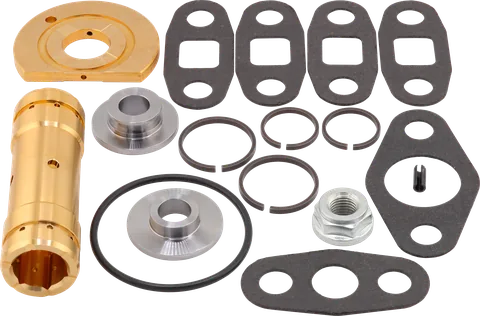
Repair kit. Consider a kit when inspection shows repairable wear and reusable major components remain within specification. Contents vary. A kit does not restore a damaged shaft, worn bearing-housing bore, or cracked wheel. Rebuilding requires proper measurements, assembly procedures, and appropriate balancing equipment.
Individual housings or wheels. The catalog includes compressor housings, turbine housings, bearing housings, compressor wheels, and turbine wheel/shaft components. These suit carefully diagnosed component repairs. Wheel replacement changes the rotating assembly and requires professional balance verification. Housing selection must match geometry, locating features, and connections.
Gaskets are also listed. Confirm the seals and gaskets required for the specific installation rather than assuming a complete turbo or cartridge includes them.
Installation Checks for Heavy Diesels
Support the turbo’s weight during removal and installation. Avoid placing that load on oil lines, exhaust connections, or manifold studs. Inspect mounting surfaces, fasteners, brackets, and exhaust alignment.
Complete these Series 60 turbocharger installation checks before fitting the replacement:
- Clean the intake and charge-air system. Inspect ducting and the intercooler for oil and fragments from the failed unit. Replace components that cannot be reliably cleaned or have internal damage.
- Inspect the oil feed and drain. Check for carbon, collapsed sections, restrictions, and damaged fittings. Ensure the drain’s routing and orientation follow the installation requirements.
- Use the correct new gaskets and seals. Prevent sealant or debris from entering oil passages. Follow specified tightening procedures.
- Check crankcase pressure. Repair ventilation restrictions and investigate excessive blow-by that could interfere with turbo oil drainage.
- Prime the turbo. Follow the supplier’s lubrication procedure, use the specified clean oil, and establish oil pressure before firing when the engine’s service procedure calls for it.
- Verify control setup. Perform any required electronic actuator calibration or relearn. Do not alter actuator stops or linkage settings by guesswork.
After startup, inspect for oil, exhaust, coolant where applicable, and charge-air leaks. Confirm oil pressure and check fault codes. Introduce load progressively while monitoring operation. Recheck connections after the prescribed operating cycle, and verify that the original symptom and its root cause are resolved.
Common Questions
How do I identify my Detroit Series 60 turbo?
Record every number on the turbo data plate, including suffixes, and photograph the complete assembly. Match the turbo assembly number and OE part number, then confirm the housings, flanges, connections, and control system. The engine family alone is insufficient.
Does low boost mean turbocharger failure?
No. Charge-air leaks, intake restrictions, exhaust leaks before the turbine, control faults, and engine problems can all reduce boost. Test those systems and inspect the turbo before deciding which component has failed.
Is some turbo shaft movement normal?
Some radial movement can be normal in an unpressurized journal-bearing turbo. Acceptable movement depends on the specific assembly and must be measured against its service limits. Blade contact, binding, or excessive axial movement requires investigation.
Can I replace only the CHRA?
Yes, when the cartridge matches the exact turbo and the reusable housings and control components pass inspection. A CHRA will not correct a cracked housing, damaged locating surfaces, or a faulty actuator.
Will a repair kit fix a smoking turbo?
Only if repairable internal wear is the cause and the remaining components meet specifications. Restricted oil drainage, excessive crankcase pressure, intake restriction, and engine wear can also cause oil-related smoke. A kit cannot correct those conditions.
Are all Series 60 turbochargers interchangeable?
No. Assemblies can differ in wheel geometry, housing A/R, flanges, connections, and boost-control hardware. Even similar catalog numbers need verification. Match the data-plate number and OE part number before ordering.
Turbocharger vs CHRA: which should I choose?
A complete turbocharger is often appropriate when several components are damaged or a housing is unusable. A matching CHRA can replace damaged internal components when the housings, locating surfaces, and control mechanism remain serviceable.
Send your Detroit Series 60 turbo data-plate number, OE part number, engine details, and photos to LeadTurbo to confirm fitment before ordering.