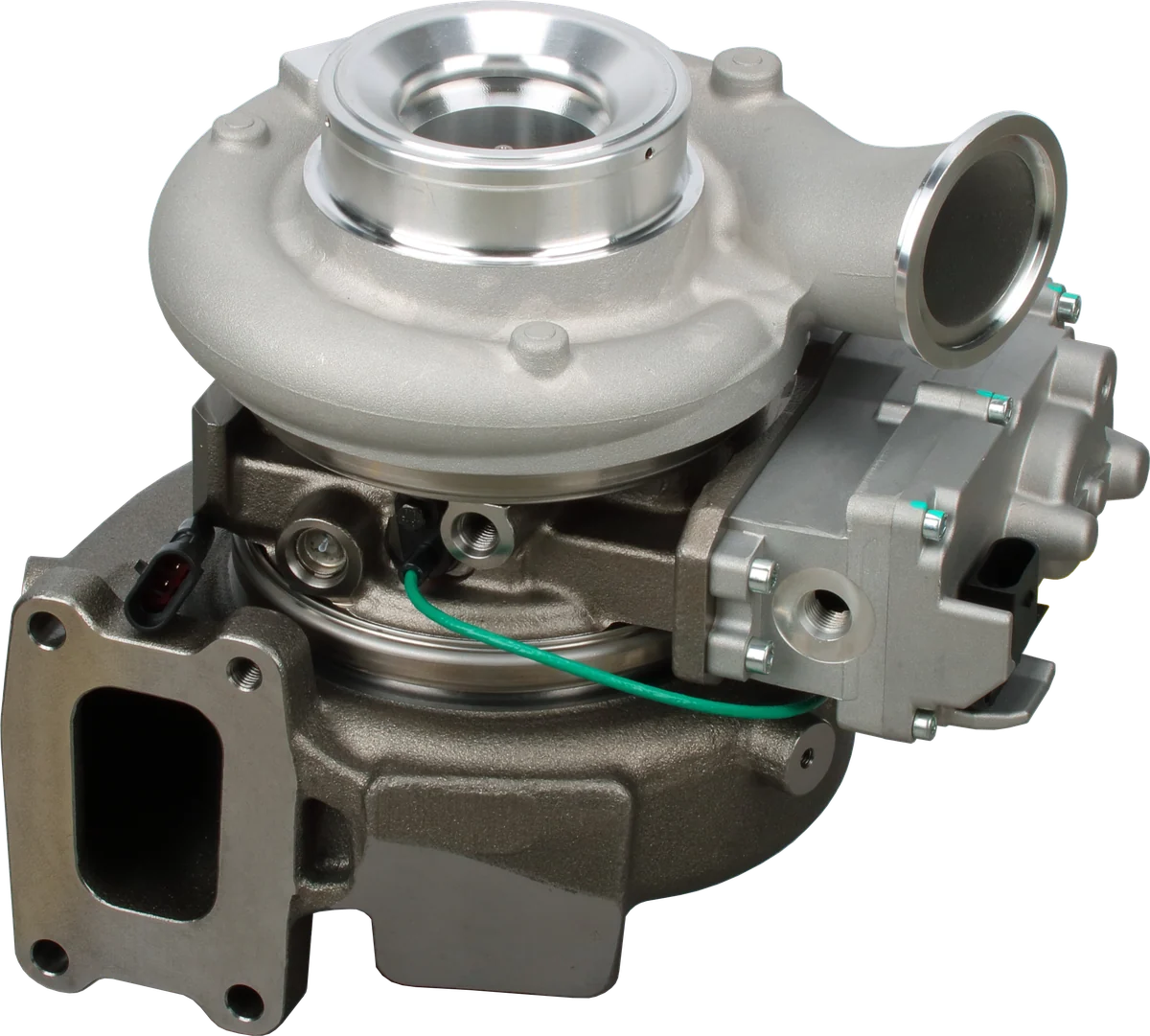
To understand how turbocharger boost supports Miller timing, technicians should treat valve timing, charge cooling, and boost as one air-management system. An engine using this strategy may need substantial compressor pressure even though it deliberately reduces the compression performed inside the cylinder. That combination explains both its emissions potential and why the correct replacement turbo matters.
How does a Miller cycle diesel work?
Miller operation makes the effective compression ratio lower than the expansion ratio. In a four-stroke diesel, the intake valves close either early, before the piston reaches bottom dead center, or deliberately late, after it has started moving upward. The piston retains its normal stroke, but the trapped charge experiences less net compression.
| Valve strategy | What happens | Air supply consequence |
|---|---|---|
| Early intake valve closing (EIVC) | The valve shuts during the intake stroke. Trapped air expands and cools as the piston continues down. | The shortened intake event limits the opportunity to admit air. |
| Late intake valve closing (LIVC) | The valve remains open into the upward stroke. Some air can return toward the intake before the charge is trapped. | Retained air mass depends on closing time and flow conditions. |
With early intake valve closing, the air must first be squeezed back to the volume it occupied when the valve closed. With late closing, the valve seals only after some upward piston travel. Both arrangements shorten effective compression while preserving the normal expansion stroke.
Neither method requires changing piston shape or clearance volume. The geometric compression ratio can remain unchanged, while the effective compression ratio falls. A conventional engine may also close its intake valves after bottom dead center; late closing alone does not establish a meaningful Miller strategy.
Why Miller diesels need more turbocharger boost
Both strategies can reduce the fresh air trapped per cycle relative to conventional timing at the same manifold conditions. To preserve oxygen supply and torque, the engine needs denser intake air. Raising intake pressure, while controlling its temperature, helps recover cylinder filling.
That is the central tradeoff in Miller cycle turbocharging: some compression duty moves out of the cylinder and into the boosted air system, where heat can be removed before the air reaches the engine. Charge cooling therefore has a direct role in making the strategy useful.
For a high boost diesel, compressor pressure ratio matters as much as the manifold boost reading. Pressure ratio compares absolute compressor outlet pressure with absolute inlet pressure. Intake restrictions, altitude, and losses through coolers and piping affect the pressure rise the compressor must provide.
The compressor also heats air as it raises pressure. Poor efficiency can erode the temperature benefit and increase turbine power demand. A single turbocharger can serve some installations; demanding applications may need two-stage compression, sometimes with cooling between stages. The required arrangement comes from the engine's airflow and pressure targets.
Higher intake pressure also changes the work required from the turbine. If the exhaust side has to create excessive back pressure to supply that work, gas exchange losses rise. Engineers therefore match the compressor, turbine, charge coolers, and valve events as a system.
Pressure alone cannot tell a technician how much oxygen was retained. Hotter charge air is less dense at the same pressure, and EGR changes the fresh-air fraction. Valve timing then determines how much of the supplied charge stays in the cylinder. Compare pressure, temperature, and airflow under the specified test conditions before treating a boost reading as proof of correct filling.
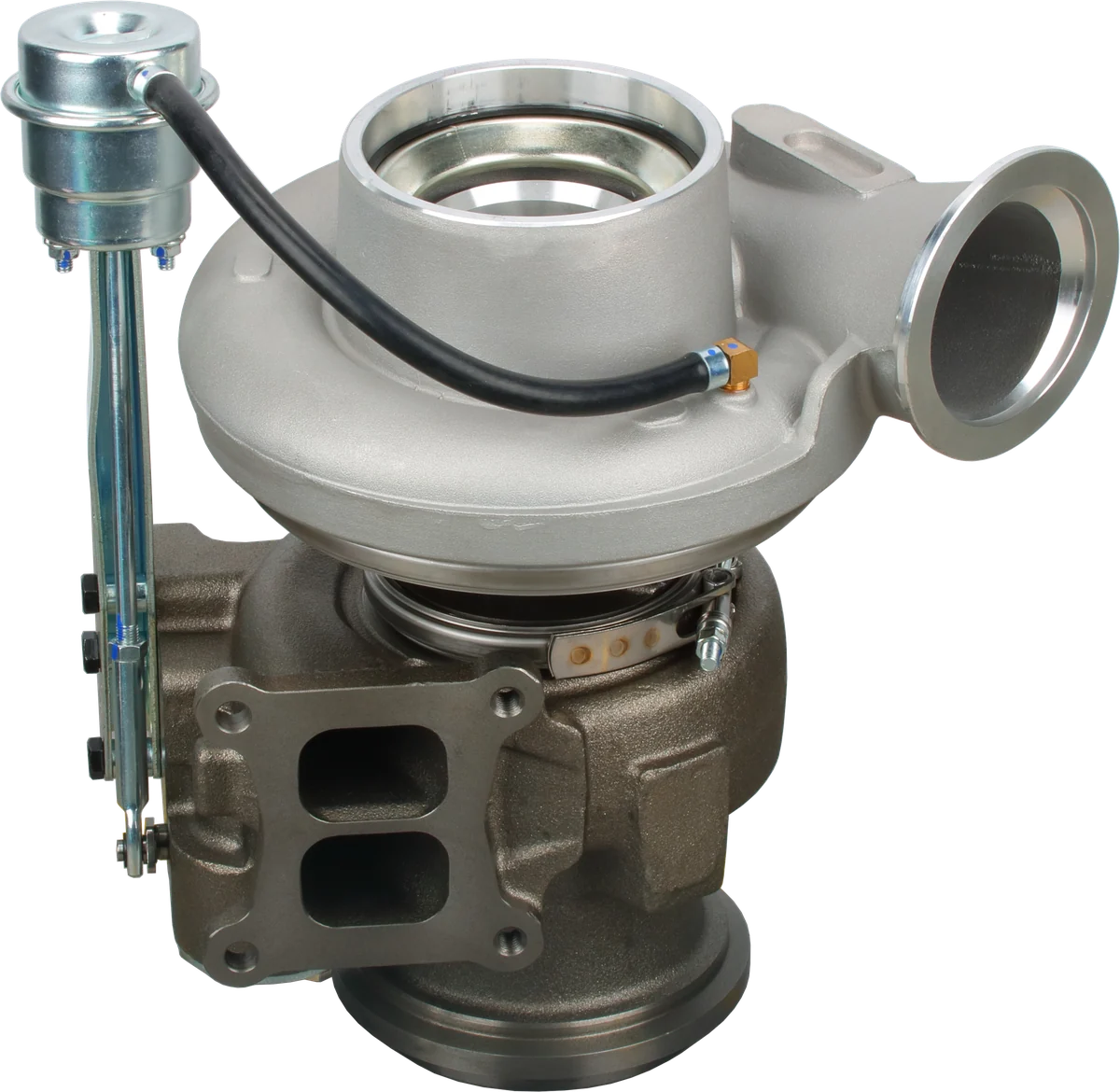
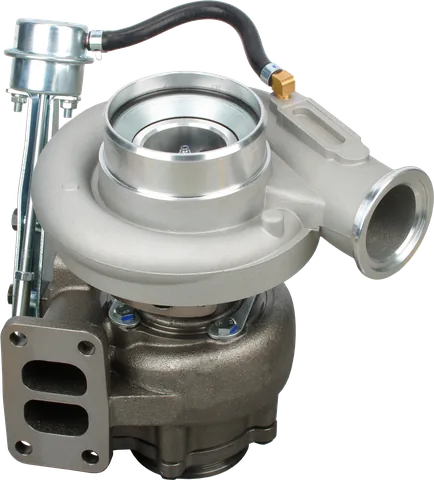
Compressor housing: guides the compressed air.
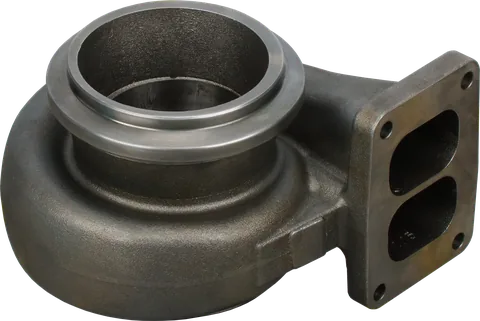
Turbine housing: guides exhaust gas to the turbine.
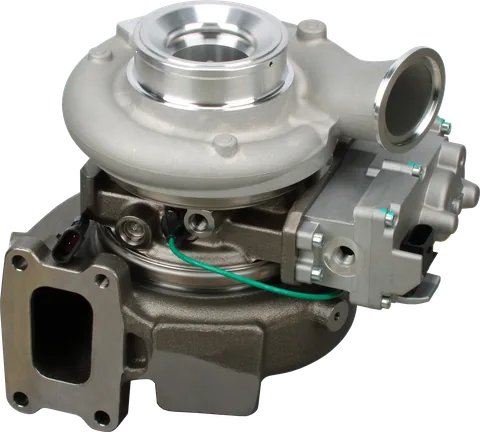
Actuator: check its type, linkage and calibration.
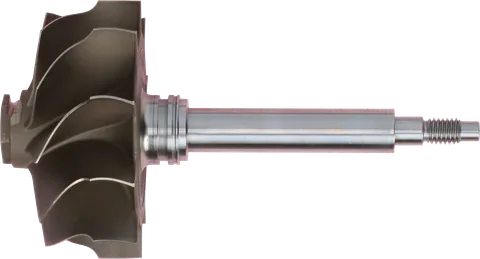
Product photograph from 2026. Numbers identify the features explained below.
What the engine gains, and what limits those gains
Lower temperature at the end of compression gives designers another way to control combustion temperature and firing pressure. The benefits depend on the chosen boost level, cooling, fueling, and valve schedule.
| Potential benefit | Why it is possible | What controls the outcome |
|---|---|---|
| Lower engine-out NOx | Reduced compression heating can reduce the hottest combustion temperatures that promote NOx formation. | Injection timing, EGR, oxygen availability, and combustion behavior still matter. |
| Lower thermal load | Lower gas temperatures can ease heat transfer into combustion chamber surfaces. | Local temperatures, operating load, and component cooling determine actual relief. |
| Higher power density | Lower compression pressure can create room for more output within firing-pressure limits. | Adequate trapped air, mechanical strength, and heat rejection capacity remain necessary. |
| Efficiency potential | Retaining the expansion ratio allows useful expansion after a shorter effective compression process. | Turbocharger efficiency and pumping losses can offset the gain. |
Miller timing does not guarantee lower fuel consumption at every operating point. Nor does lower cylinder temperature establish a safe turbine inlet temperature: combustion phasing and emissions strategies can alter exhaust conditions. Turbocharger temperature and speed limits still apply.
Reduced cylinder heat loading can coexist with greater compressor work, which makes the turbo specification especially important.
Why low-speed response can suffer
At low engine speed, exhaust energy may be insufficient to produce the boost demanded by aggressive Miller timing. If intake timing reduces the retained charge before boost arrives, the engine has less oxygen available for added fuel. The control system may limit fueling, making torque buildup feel slower.
During a sudden load increase, turbo speed, manifold pressure, and valve timing must move together. Poor coordination can produce weak response or smoke. On a working machine, those symptoms justify comparing requested and actual air-system behavior under the specified operating conditions.
- Check commanded intake timing and available feedback at the affected speed and load.
- Verify boost, airflow, and charge temperature against the specification for that valve mode.
- Account for altitude and intake restrictions when interpreting compressor demand.
Duty cycle also matters. Equipment that spends long periods at a stable speed and load can be optimized around that operating point. Trucks and loaders need useful torque through frequent speed changes. Generator sets may run at constant speed but still face sudden load steps, so their transient air supply also needs careful control.
Some engines use variable turbine geometry, staged boost control, or a milder valve schedule to manage these conditions. A correctly functioning engine may still have a different torque response from a conventional design, but a new loss of response deserves investigation.
How variable valve timing helps
A fixed intake cam can provide Miller timing, so variable valve timing is not essential to the definition. Its value is adaptability: the engine can reduce the Miller effect when starting or building torque, then use a stronger effect when enough boost is available.
Depending on the design, cam phasing, switchable valve events, or variable valve actuation can adjust intake closing. Moving an entire cam event also changes opening timing and overlap; a system that changes duration or closing independently has different control options.
Cold starting exposes the other side of reduced compression heating. Diesel fuel needs sufficiently hot compressed air to ignite reliably. Depending on the engine, starting may involve a different valve event, intake heating, or other starting aids. A fixed cam cannot switch its closing event for starting.
The original calibration coordinates these choices with injection, EGR where fitted, and turbo control. There is no universal closing angle or boost setting to apply across engines. A valve-actuation fault can therefore disturb the air balance even when the turbocharger itself remains mechanically sound.
Miller timing vs variable compression
Mechanical variable compression changes the engine's geometry, such as clearance volume or the piston position at the top of its stroke. Proposed and developed mechanisms include movable piston elements and adjustable linkages. These add moving parts, control requirements, and durability challenges.
The shared aim is to preserve useful compression for starting and light-load operation while allowing higher-load operation within pressure limits. Miller timing pursues that flexibility through the intake event. Mechanical variable compression should not be assumed merely because an engine uses Miller timing, and it is not a routine turbo replacement modification.
Which turbocharger fits a Miller cycle diesel?
On a Miller cycle diesel, the compressor must deliver the intended airflow at the required pressure ratio across the engine's working range. High pressure ratio capability alone is insufficient: compressor efficiency, turbine power, shaft-speed limits, and boost control all have to fit the application.
A precise match to the original-equipment (OE) specification matters. A turbo that bolts onto the manifold may deliver the wrong airflow, reach a speed limit too soon, or respond incorrectly to the engine controller.
| Match item | Why it matters |
|---|---|
| Complete turbo assembly number and approved supersession | Establishes the intended hardware specification for the application. |
| Engine serial number, rating, and emissions configuration | Identifies differences that can change airflow and control requirements. |
| Stage position on a two-stage system | Identifies the correct high-pressure or low-pressure unit and its control arrangement. |
| Actuator type and specified calibration | Keeps boost-control commands consistent with the installed hardware. |
| Approved CHRA and internal parts | Preserves the compressor, turbine, and bearing specification when rebuilding an existing assembly. |
Before ordering, confirm these turbocharger requirements for Miller cycle diesels:
- The part number applies to the engine's actual rating and configuration.
- Any required actuator setup or adaptation follows the engine manufacturer's procedure.
- A replacement core is explicitly approved for the complete turbo assembly.
Changing a compressor wheel or fitting a larger turbo without an approved match can upset the relationship between valve timing and trapped air. Restore the specified combination so the engine can achieve its intended boost, temperature, and torque targets.
Common Questions
Does Miller timing change the geometric compression ratio?
Miller timing changes effective compression through valve timing while leaving the geometric compression ratio unchanged. Mechanical variable compression changes cylinder geometry and is a separate approach.
Does higher boost cancel the temperature benefit?
Higher boost heats the compressed air. Efficient turbocharging and charge cooling help manage that heat, allowing reduced effective compression to retain a temperature advantage.
Is two-stage turbocharging always required?
No. A single turbocharger can support some applications. Two stages become useful when the required airflow, pressure ratio, and operating range exceed a suitable single-stage system's capabilities.
Can Miller timing make cold starting harder?
It can if reduced compression leaves insufficient temperature for ignition. Engines with variable valve control may use less aggressive Miller timing during starting and warm-up.
Does Miller timing replace EGR or SCR?
No. Miller timing can reduce engine-out NOx, but EGR, SCR, and their controls remain part of the engine's approved emissions configuration where fitted.
Can I fit a larger turbo to a Miller cycle diesel?
Use the approved match for the engine. A larger compressor alone does not establish suitable pressure ratio, response, or actuator behavior, and may compromise the intended air supply.
What causes Miller cycle turbocharger boost problems?
Boost problems can result from insufficient exhaust energy at low engine speed or valve-actuation faults that disturb the air balance. Check commanded intake timing and available feedback, then compare boost, airflow, and charge temperature with specifications for the affected speed, load, and valve mode. Account for intake restrictions and altitude when interpreting compressor demand.
Contact LeadTurbo with your turbocharger part number and engine details for help checking the correct replacement.