Two diesel engines can use similar-looking turbochargers yet deliver exhaust energy to them very differently. One system preserves distinct pressure bursts; another combines those bursts into a steadier supply. That choice affects response, gas exchange, and the turbine's operating conditions. It also explains why a replacement housing with the right bolt pattern may still be the wrong part.
How does exhaust power a turbocharger?
The turbine produces shaft power as hot, pressurized exhaust expands through it. The compressor then uses that power to supply the engine with air. Exhaust temperature matters, but temperature alone cannot tell you how much useful turbine work is available: mass flow, inlet pressure, outlet pressure, and turbine efficiency all matter.
When an exhaust valve opens, the cylinder still contains pressurized gas. Its initial release creates a rapid pressure rise and a fast-moving discharge into the exhaust passage. This is the blowdown event. Recovering useful work from blowdown means preserving some of that work potential until the gas reaches the turbine.
After the initial release, the rising piston pushes out the remaining exhaust. This later discharge continues feeding hot gas into the manifold. Across several cylinders, overlapping exhaust events can create a relatively continuous supply even though each cylinder empties intermittently.
Diesel turbocharger exhaust flow is not exclusively pulsed or steady in either arrangement. Both use hot exhaust with pressure available for expansion. The distinction is how much of the original exhaust pulse energy survives as useful variation in pressure and flow at the turbine inlet.
How does pulse turbocharging use exhaust energy?
A pulse system keeps the volume between exhaust valves and turbine relatively small. A compact passage allows pressure to build quickly when a cylinder discharges, rather than spreading that event through a large receiver. The turbine sees a succession of stronger peaks and quieter intervals.
Cylinders sharing a passage are selected by firing order and exhaust-event timing. The aim is to prevent one cylinder's blowdown from disturbing another cylinder while it finishes exhausting. Cylinder numbers alone are not a grouping rule. A divided exhaust manifold maintains selected groups separately toward the turbine.
This can improve scavenging, meaning the removal of residual exhaust gas. During valve overlap on a four-stroke engine, lower local exhaust pressure relative to intake pressure can help fresh air clear the cylinder. An unwanted neighboring pulse can reduce that pressure difference or reverse it. The benefit therefore depends on valve timing and pressure throughout the event.
The practical advantage of pulse turbocharging is strongest when the engine needs useful turbine work before average exhaust flow becomes large. Preserved pulses and limited manifold volume can support low-speed response. They do not eliminate lag or guarantee better operation at every load. The pulse advantage is largest at moderate boost: as pressure ratio rises, the extra energy recovered from pulses becomes a smaller share of total turbine work, while pulse-related turbine efficiency losses remain.
The tradeoff is an uneven turbine supply. Pressure, flow, and admission vary through the cycle, so the wheel does not continuously operate at its most efficient condition. Smaller passages also need enough flow capacity at high load; simply making runners narrower is not an upgrade.
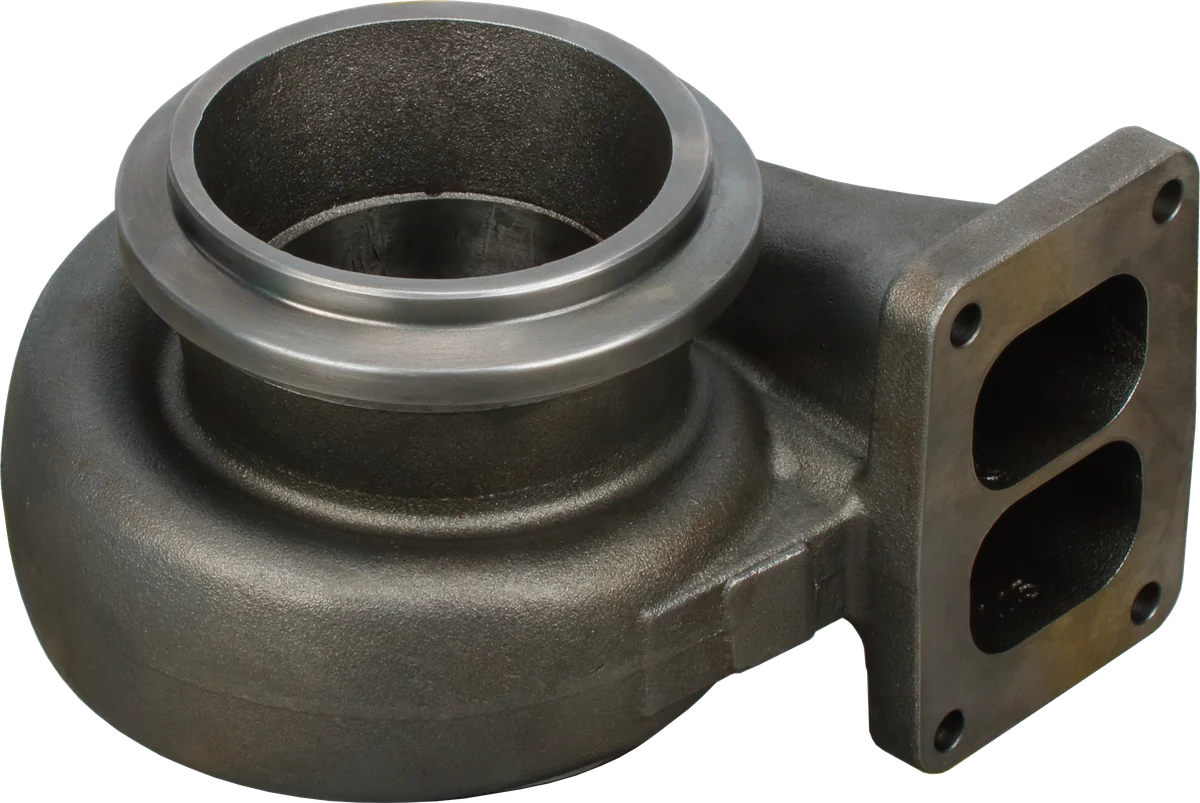
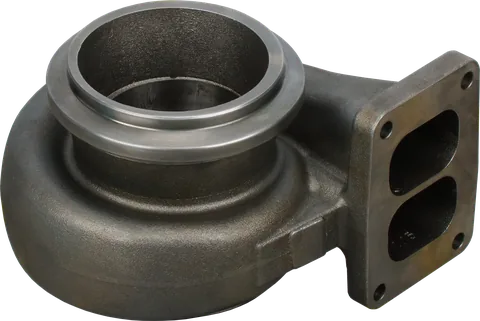
Exhaust inlet: verify the flange and passage geometry.
Turbine cavity: check clearance and contact damage.
Mounting face: the replacement must match the interfaces.
Product photograph from 2026. Numbers identify the features explained below.
Pulse vs constant pressure turbocharger systems
Constant pressure turbocharging uses a large common receiver, or plenum, to blend the cylinders' exhaust events. Its volume damps the individual pressure peaks, giving the turbine a steadier inlet condition at a particular engine operating point. Pressure still changes when load or speed changes.
Smoothing has a cost. Expansion and mixing upstream of the wheel reduce the work potential associated with distinct blowdown pulses. That does not mean all their energy disappears: the mixed gas remains hot and pressurized, and the turbine still recovers expansion work from it.
In return, the turbine can operate with more uniform flow and, where the arrangement permits, full admission around its inlet. A well-matched turbine can achieve higher average efficiency under steady high-load conditions. At light load or during acceleration, however, the weaker pressure difference and larger receiver can make the system less responsive.
| Design question | Pulse system | Constant-pressure system |
|---|---|---|
| What reaches the turbine? | Distinct pressure and flow bursts | A more even combined stream |
| Where is the advantage strongest? | Low-speed and changing-load operation | Sustained high-load operation |
| How does the turbine operate? | Wide variation within the exhaust cycle | More stable inlet conditions |
| What must be managed? | Pulse interference and fluctuating admission | Mixing losses and transient air delivery |
Match the system to the duty cycle
Application labels offer a starting point, not a fitment rule. Road engines and marine engines that change speed and load frequently can benefit from strong pulse utilization. High-load stationary engines and generator sets can benefit from a steady turbine supply. Construction and farm equipment also need to be judged by their actual work cycle.
| Application | Main operating demand | Arrangement that often fits |
|---|---|---|
| Road trucks, buses, and pickups | Repeated changes in speed and load | Pulse or mixed systems |
| Marine propulsion with frequent maneuvering | Torque pickup and air delivery below rated power | Pulse or mixed systems |
| Marine propulsion held near a steady service load | Sustained efficiency at the chosen rating | Constant-pressure or mixed systems |
| Stationary engines and generator sets carrying sustained high load | Efficient continuous operation | Constant-pressure or mixed systems |
| Standby or variable-demand generator sets | Sudden load acceptance despite constant governed speed | Selection depends on transient requirements |
A generator's constant governed speed does not mean constant load. A unit accepting abrupt electrical load steps has a different response requirement from one carrying a stable load for hours. Likewise, a marine engine used for maneuvering and one running steadily offshore need not favor the same arrangement.
Where pulse converters and multi-pulse systems fit
Real exhaust systems do not always sit neatly at either extreme. A turbocharger pulse converter combines separated branches through shaped restrictions and a mixing section. Gas from an active branch gains velocity, and its momentum can help draw flow from another branch while limiting harmful pressure communication.
The objective is to retain useful energy transfer from pulses upstream while presenting the turbine with a smoother combined flow. Achieving that balance depends on branch timing, passage geometry, and operating condition. The converter itself introduces restriction and mixing losses, so its benefit must be assessed as part of the complete engine.
Multi-pulse arrangements bring together more exhaust events through carefully organized collectors. Depending on the design, they can preserve useful low-load pulse behavior while approaching steadier turbine operation at higher load. A common-looking collector therefore does not automatically identify a conventional constant-pressure system.
Why the manifold and turbine inlet must match
The manifold and turbine housing form one gas path. If the engine was designed to keep two cylinder groups separate up to the turbine, the replacement parts must preserve that separation. A divided inlet is useful only when the upstream routing and internal housing geometry support the intended arrangement.
| Existing exhaust path | Replacement inlet | What to establish |
|---|---|---|
| Separated manifold branches | Matching divided housing | The divider and passages preserve the specified flow paths. |
| Separated manifold branches | Open housing | The junction can allow cross-communication and change pulse delivery. |
| Common open collector | Divided housing | The divider cannot recreate cylinder separation already lost upstream. |
| Pulse converter or multi-pulse collector | Specified single or divided inlet | Compatibility depends on the complete matched system. |
These combinations are not approval rules based on appearance. Some engines use deliberately engineered transitions. The problem is substituting a different arrangement without knowing whether it belongs to that engine specification. An inlet adapter that creates an open cavity can change the pulse path even when both connected flanges appear divided.
How to check replacement turbocharger compatibility
For a replacement turbocharger or turbine housing, confirm the exhaust arrangement before treating matching mounting dimensions as proof of compatibility.
- Record the complete turbocharger part number and the engine's model, power rating, and application. Similar engines can have different exhaust configurations.
- Identify the manifold outlet and turbine inlet as a pair. Check the divider's position and whether separation continues through any connecting passage.
- Compare the specified turbine housing and wheel combination. Inlet style alone does not establish the required flow capacity.
- Check adapters and gaskets against the intended passage layout. A gasket cannot maintain separation across an open space behind it.
- For a CHRA replacement, retain a compatible housing specification. Renewing the core does not correct an unsuitable exhaust system arrangement.
- If the manifold or housing has previously been changed, verify the current combination against the engine's approved configuration before ordering.
A familiar housing size or matching A/R marking is not enough by itself. Internal geometry and the matched turbine specification still matter.
Common Questions
Does constant pressure mean the exhaust pressure stays fixed?
No. Pressure still changes with engine load, speed, and turbine flow capacity. The name describes reduced pressure fluctuation between individual exhaust events at a given operating condition.
Can a single-entry turbocharger use exhaust pulses?
Yes. A single cylinder group can feed one inlet, and some mixed systems combine pulses before the turbine. An open inlet alone does not prove that the engine uses a constant-pressure layout.
Which system is better for a generator set?
That depends on its operating schedule and load-step requirements. Sustained high-load operation can favor a constant-pressure arrangement, while demanding transient operation can favor pulse-based or mixed designs. Follow the engine manufacturer's matched specification.
Can I replace a divided housing with an open housing?
Only when the engine or turbocharger supplier approves that exact configuration. Matching the bolt pattern does not establish compatibility. Changing the inlet arrangement can alter pulse separation, turbine flow, and engine response.
Is pulse turbocharging the same as twin-scroll?
No. The first term describes how the exhaust system delivers energy; twin-scroll describes a housing with two separate turbine inlet paths. A divided housing supports pulse separation only when the upstream manifold preserves the intended cylinder grouping.
What affects turbocharger response after turbine housing replacement?
Turbocharger response depends on the inlet arrangement, pulse separation, and turbine flow. Check that the manifold, housing divider, adapters, and gaskets follow the intended passage layout, and confirm the specified housing and wheel combination. Matching mounting dimensions or an A/R marking alone does not establish compatibility.
Contact LeadTurbo with your turbocharger part number, engine model and rating, and inlet photos for help confirming the correct replacement configuration.