Knowing how to read turbocharger specifications means understanding what they describe, where measurements were taken, and which operating conditions apply. A pressure reading, wheel dimension, or housing label rarely tells the whole story.
This glossary groups diesel turbocharger terms by function for quick reference at the parts counter or beside an engine.
Engine and boosting: turbocharger terms for pressure and system layout
Start with the pressure reference and air path before comparing boost figures or system descriptions.
| No. | Term | Meaning |
|---|---|---|
| 1 | Turbocharging | Using an exhaust-driven turbine to power a compressor that raises intake-air density. A turbocharger supplies additional air; fuel delivery and engine limits determine how much extra output is available. |
| 2 | Supercharging | Broadly, supplying an engine with pressurized intake air; in everyday shop usage, it usually means using a compressor driven mechanically by the engine. That drive takes power from the crankshaft. |
| 3 | Boost pressure | Usually, the amount intake pressure exceeds local atmospheric pressure. A specification may instead use absolute pressure, so confirm both the reference and the measurement location. |
| 4 | Absolute pressure | Pressure measured from a perfect vacuum, while gauge pressure uses local atmospheric pressure as its reference. Compressor pressure ratios require absolute pressures at both inlet and outlet. |
| 5 | Pressure ratio | Compressor outlet absolute pressure divided by compressor inlet absolute pressure, using the specified pressure convention. This dimensionless value describes compression demand, which can rise when restrictions reduce inlet pressure. |
| 6 | Boost level (low/medium/high) | Relative labels with no universal pressure cutoff across diesel engines. Ask for the actual pressure, whether it is gauge or absolute, and where it was measured. |
| 7 | Sequential turbocharging | A layout in which a second turbocharger is brought into operation as airflow demand rises, so a smaller unit can serve low speeds and both serve high flow. |
| 8 | Turbocompounding | Recovering exhaust energy as shaft or electrical power beyond what the compressor needs, for example with a power turbine geared to the crankshaft. |
| 9 | Single-stage turbocharging | Intake air passes through one compressor stage before entering the engine. Two turbochargers working in parallel can still form a single-stage system because neither compressor feeds the other. |
| 10 | Two-stage turbocharging | Air passes through two compressor stages in series, with each stage adding compression. This describes the air path; it does not necessarily mean the turbos switch on sequentially. |
| 11 | Compound charging | In diesel shop usage, commonly two turbochargers compressing the same air stream in series. The term can also describe combinations of a turbocharger and a mechanical supercharger, so confirm the arrangement. Not the same as turbocompounding. |
| 12 | Intercooler / aftercooler | A heat exchanger that cools compressed intake air, increasing its density at a given pressure. Strictly, intercooling occurs between compression stages and aftercooling follows final compression, although parts listings often use the names interchangeably. |
For an illustrative example, assume 15 psia at the compressor inlet and 30 psia at its outlet. The pressure ratio is 2.0, while outlet gauge boost is 15 psi if local atmosphere is also 15 psia. A quoted “boost pressure ratio” therefore needs absolute inlet and outlet pressures.
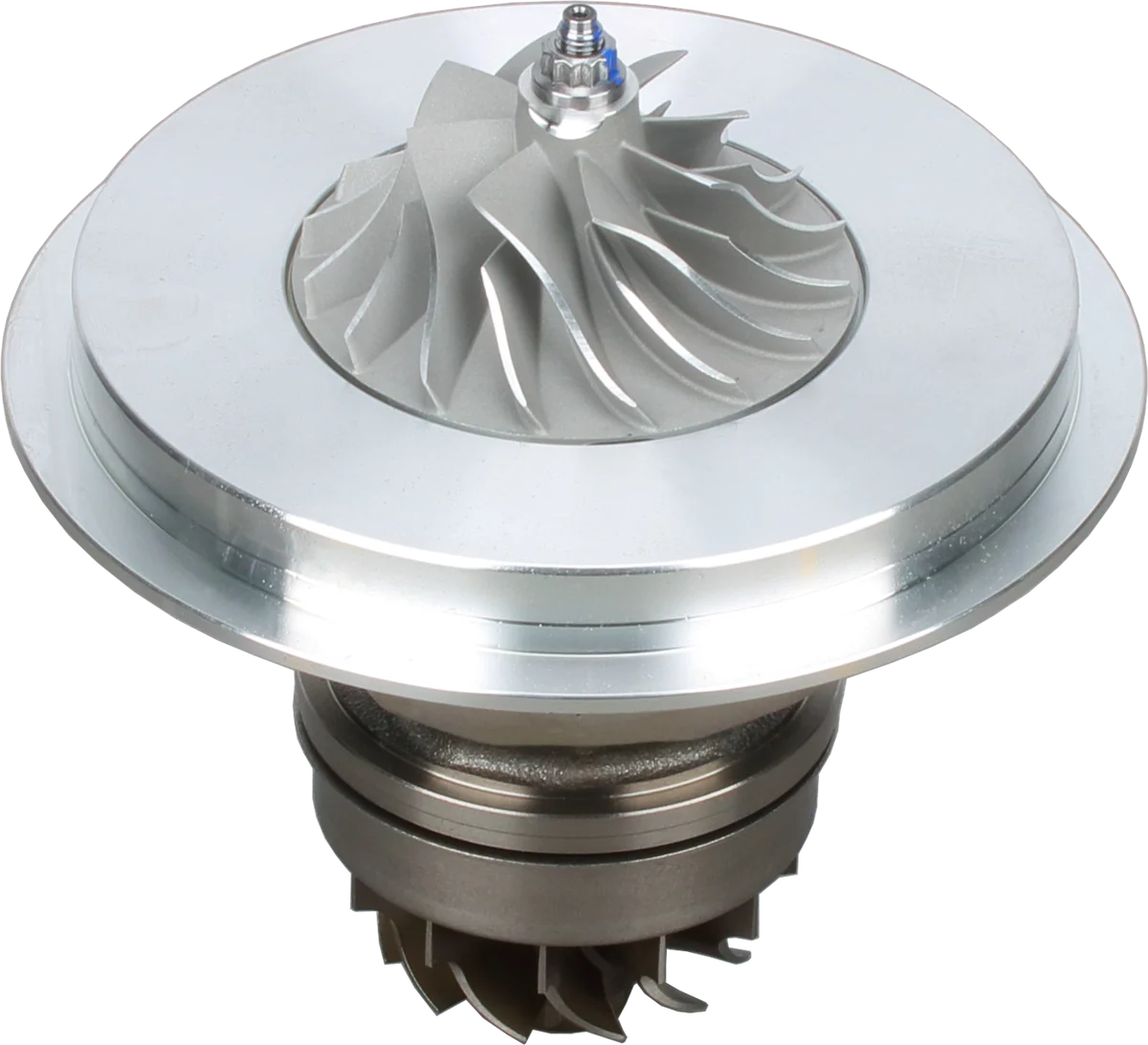
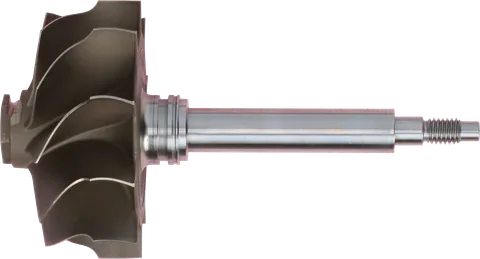
Compressor wheel: transfers shaft power to the air.
Bearing housing: supports the lubricated rotating assembly.
Turbine wheel: exhaust energy drives the shaft.
Product photograph from 2026. Numbers identify the features explained below.
Compressor: turbocharger inducer vs exducer and airflow behavior
Compressor terminology describes both physical parts and how they perform across different airflow conditions.
| No. | Term | Meaning |
|---|---|---|
| 13 | Compressor wheel | The rotating wheel that adds energy to intake air; the compressor diffuser then converts part of the flow's velocity into pressure. Blade geometry and housing design both affect performance. |
| 14 | Inducer | The inlet portion of a wheel, where air or exhaust enters its blades. The compressor inducer is normally the smaller wheel diameter; a typical radial turbine has a larger inducer. |
| 15 | Exducer | The outlet portion of a wheel, where flow leaves the blades. It is normally the larger diameter on a centrifugal compressor and the smaller diameter on a radial turbine. |
| 16 | Trim | A percentage based on the squared smaller wheel diameter divided by the squared larger diameter. Trim alone cannot establish wheel size, blade design, or airflow capacity. |
| 17 | Surge | Unstable compressor operation when the pressure demand is too high for the airflow, potentially causing flow oscillation or reversal. On a map, the surge boundary marks the low-flow side of stable operation. |
| 18 | Choke | A compressor flow limit associated with sonic velocity in a limiting passage. Operating near it can reduce efficiency and require excessive turbo speed for the requested pressure ratio. |
| 19 | Efficiency island | A region on a compressor map showing a stated efficiency range. At the same inlet conditions and pressure ratio, better efficiency means less required compressor work and less air heating. |
Turbine: exhaust energy and housing geometry
| No. | Term | Meaning |
|---|---|---|
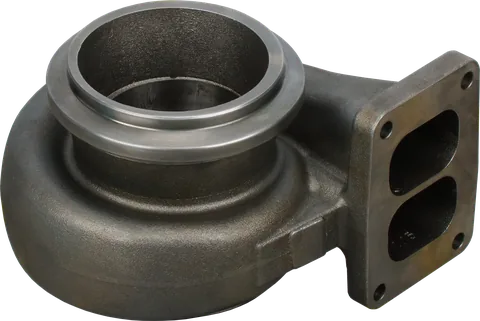
| 20 | Turbine wheel | The wheel driven by expanding exhaust gas, which turns the shaft and compressor. Its flow capacity and energy extraction affect boost response and exhaust pressure. |
| 21 | A/R | Housing passage cross-sectional area divided by the radius from the shaft centerline to that area's centroid. Use it within a specified housing family; identical A/R numbers do not guarantee identical flow capacity. |
| 22 | Pulse turbocharging | An exhaust arrangement that preserves individual cylinder pressure pulses as they reach the turbine. Manifold grouping and volume influence how effectively those pulses deliver energy and how cylinders affect one another. |
| 23 | Constant-pressure turbocharging | An exhaust arrangement using a shared volume to smooth cylinder pressure pulses before the turbine. The turbine receives a steadier flow, although pressure still varies with engine operation. |
| 24 | Exhaust back pressure | Pressure opposing exhaust flow at a stated measurement point. Pressure before the turbine and restriction after it describe different conditions, so a back pressure figure needs a location and pressure reference. |
Bearings and seals: inside the center housing
These turbocharger CHRA components sit inside the center housing and are usually sold within a CHRA or repair kit.
| No. | Term | Meaning |
|---|---|---|
| 25 | CHRA | Center housing rotating assembly: the center housing, shaft and turbine wheel, compressor wheel, bearings, and sealing components. It generally excludes the outer compressor and turbine housings; confirm exactly what the supplier includes. |
| 26 | Floating bearing | A journal bearing arrangement that supports radial loads through oil films between shaft and bearing and between bearing and housing. A fully floating ring can rotate; a semi-floating bearing is restrained against rotation. |
| 27 | Thrust bearing | The bearing that controls axial shaft movement caused by pressure and momentum forces acting on the wheels. It carries end loads, while the journal bearing system primarily supports radial loads. |
| 28 | Piston ring seal | A small split metal ring used within a turbo's sealing arrangement to restrict leakage between cavities. It works with surrounding geometry, pressure conditions, and oil drainage to help control gas and oil leakage. |
| 29 | Shaft play | Measured radial or axial movement of the rotating assembly. Assessment depends on bearing type, test conditions, and the specified limit; dry journal bearing clearance alone does not establish serviceability. |
Control: regulating turbine drive and boost
| No. | Term | Meaning |
|---|---|---|
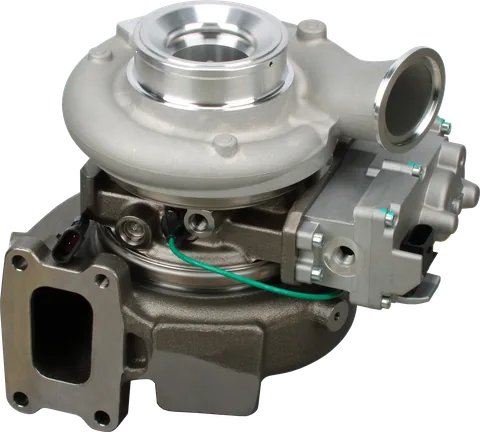
| 30 | VGT | Variable geometry turbocharger: a turbo that changes turbine flow geometry, commonly through movable vanes. The control system adjusts turbine behavior for functions such as boost regulation, exhaust braking, and emissions management. |
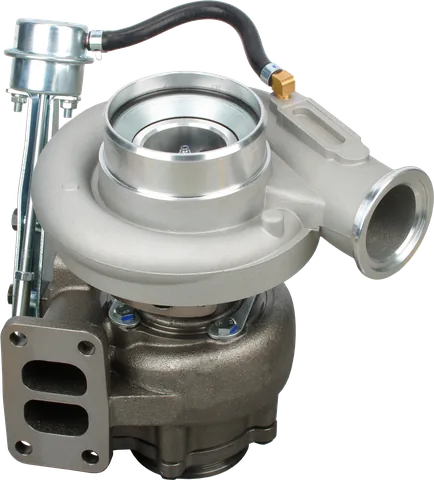
| 31 | Wastegate | A valve that allows some exhaust to bypass the turbine wheel, reducing the energy driving the shaft. It helps regulate boost and turbo speed. |
| 32 | Actuator | The device that moves a wastegate valve or variable geometry mechanism, using pneumatic or electric force. Correct travel, position feedback where fitted, and calibration matter when identifying a replacement. |
| 33 | Turbo lag | The delay between an increase in engine demand and the resulting boost response. Exhaust energy, rotating inertia, controls, and the volume of the intake system all influence it. |
Testing and matching: interpreting performance information
| No. | Term | Meaning |
|---|---|---|
| 34 | Compressor map | A chart relating compressor pressure ratio to airflow, with efficiency regions and speed lines. Read its units, reference conditions, and pressure convention before comparing operating points. |
| 35 | Corrected airflow | Air mass flow adjusted to stated reference inlet conditions so compressor performance can be compared consistently. A corrected airflow figure is not automatically the actual mass flow entering the engine. |
| 36 | Operating point | The combination of airflow and pressure ratio representing a particular engine condition on a compressor map. A useful assessment considers several load and speed conditions across the engine's operating range. |
| 37 | Turbo matching | Selecting a turbo system whose airflow, pressure capability, turbine behavior, and controls suit the engine's operating requirements. Physical fit is one part of matching a replacement or application. |
| 38 | Balancing | Measuring and correcting uneven mass distribution in rotating parts or an assembled rotating unit. Component balancing and checks of the assembled rotor describe different stages of this work. |
| 39 | Overspeed | Operation above the turbocharger's permitted shaft speed. A normal manifold boost reading does not rule it out, because inlet conditions, restrictions, and the required compressor pressure ratio affect speed. |
| 40 | Duty cycle | The pattern of loads, speeds, and running time an engine experiences in service. Sustained generator loading and changing truck loads can place different thermal and response demands on a turbocharger. |
Using the glossary at the parts counter
Use these turbocharger terms to clarify a specification and understand how to identify a replacement turbocharger before treating two parts as equivalent:
Core is a common source of confusion: it can mean a used turbocharger or CHRA returned under an exchange program, or, in some listings, the center assembly itself.
- Check pressure labels: Record gauge or absolute pressure, units, measurement location, engine speed, and load.
- Check wheel dimensions: Identify compressor or turbine, then inducer or exducer, before comparing measurements.
- Check assembly contents: Establish whether the listing covers a CHRA, complete turbocharger, actuator, or individual component.
- Check control details: Confirm the wastegate or VGT arrangement and the specified actuator configuration.
- Check identity: Keep the complete part number and engine application details alongside dimensional or performance descriptions.
These checks make a conversation more precise, especially when a catalog uses shorthand. They also help separate a component description from a claim that it will fit and operate correctly.
Common Questions
Is boost pressure the same as pressure ratio?
No. Boost commonly means pressure above local atmosphere, while pressure ratio compares absolute pressures across the compressor. A manifold boost reading alone cannot give an exact compressor pressure ratio because intake and charge-air pressure losses also matter.
Do low, medium, and high boost have fixed pressure ranges?
No universal ranges apply across diesel engines. Treat these as relative descriptions unless a manufacturer defines them, and use the engine's specified pressure limits and measurement conditions for service decisions.
What is a turbocharger core?
A core can mean a center assembly in a parts listing or a used turbocharger returned under an exchange program. Confirm the listing's meaning, included components, and any return requirements before ordering.
Is a VGT turbo the same as a wastegated turbo?
No. A VGT changes turbine flow geometry, while a wastegate diverts exhaust around the turbine wheel. Identify the specified control hardware and actuator, because similar housings do not establish interchangeability.
Which turbocharger terms matter most when ordering parts?
Start with CHRA, actuator, VGT or wastegate, and the housing and wheel descriptions. Then verify the full turbocharger part number and engine details; glossary labels and dimensions alone do not confirm fitment.
Why do turbocharger boost readings differ?
Confirm the pressure reference, measurement location, engine speed, and load before comparing readings. Gauge and absolute pressures use different references; intake and charge-air pressure losses also matter.
Contact LeadTurbo with your turbocharger part number and engine details if you need help identifying replacement parts.