For a truck that pulls normally when cool but loses strength on a long grade, boost alone does not tell the whole story. Its real job goes beyond lowering a temperature reading. It helps keep the engine's air supply dense as the turbocharger works harder. Checking that job means measuring temperature, pressure, and leakage under load.
Turbocharger vs intercooler: why compressed air needs cooling
Compressing air takes work, and that work raises its temperature. The compressor therefore delivers air that is pressurized and hot, even when the air filter is drawing cool outside air. The amount of heating depends partly on pressure ratio and compressor efficiency.
The intercooler, often called a charge-air cooler, is a heat exchanger between the compressor discharge and the engine intake. Heat passes from charge air through metal surfaces to outside air or a cooling liquid. The turbocharger supplies pressure; the cooler removes some of the heat added during compression.
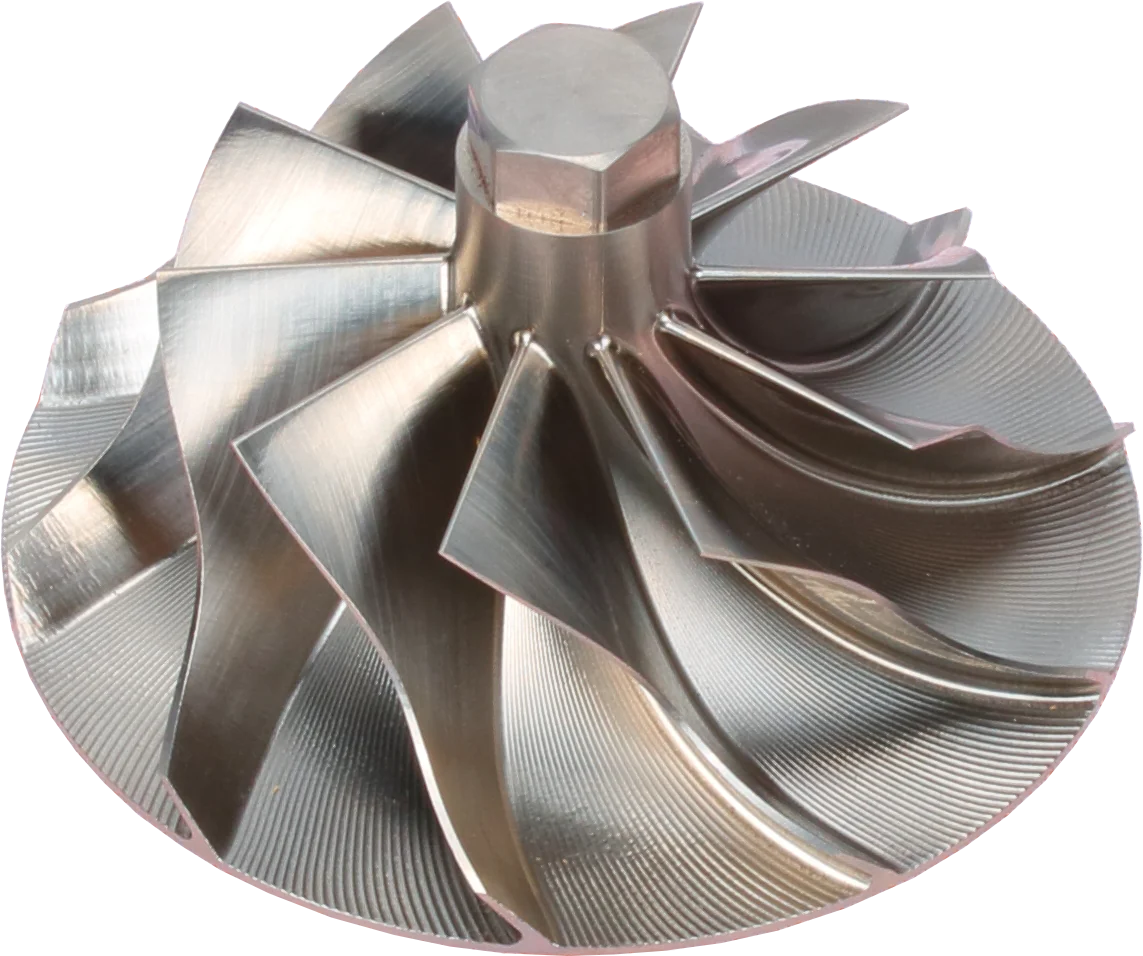
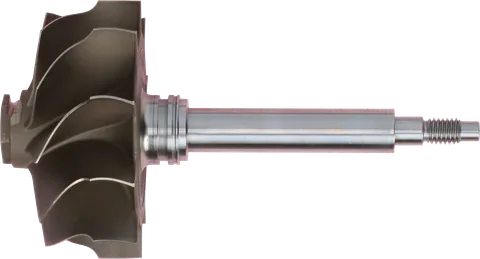
Blades: inspect for chips, bends and contact marks.
Hub: part of the balanced rotating assembly.
Outer blade tips: check for housing rub.
Product photograph from 2026. Numbers identify the features explained below.
Same boost, more air: the density effect
Boost measures pressure, not the mass of oxygen entering a cylinder. At the same absolute manifold pressure—boost plus atmospheric pressure—cooler air is denser. With comparable cylinder filling, each intake cycle can contain more air and therefore more oxygen.
Illustrative example: Air at 60°C (140°F) is about 27% denser than air at 150°C (302°F) at equal pressure. This comparison uses absolute temperature; dividing Celsius or Fahrenheit readings would give the wrong answer. It does not predict a 27% power increase.
| Area | What charge cooling can change |
|---|---|
| Power | More available oxygen can support more fuel burned effectively, within the engine's calibration and hardware limits. |
| Fuel economy | Restoring adequate air can improve combustion under load; it does not guarantee a fixed fuel-saving percentage. |
| Thermal load | At comparable load and fueling, cooler intake air can help reduce exhaust and component temperatures. |
| NOx emissions | Lower peak combustion temperatures can reduce nitrogen oxide formation, but oxygen availability, injection timing, and exhaust gas recirculation affect the result. |
At unchanged fueling, extra oxygen alone will not produce a proportional torque increase. The engine controller may also limit fuel when it detects excessive intake temperature, so restored cooling can recover lost performance.
Knock-free diesel combustion requires more than cold air. Diesels intentionally use compression ignition, and diesel knock involves a rapid pressure rise after ignition delay. Excessively cold intake conditions can lengthen that delay and produce a harsher initial burn. Intercooling helps maintain the intended thermal operating range, but knock margin still depends on injection strategy, fuel quality, and engine conditions.
Judge cooling against the available temperature difference
The temperature drop alone does not describe intercooler effectiveness. A useful shop measure compares the drop achieved with the gap between hot charge air and the cooling medium entering the cooler.
Illustrative temperatures only, not service limits:
| Measurement | Example |
|---|---|
| Charge air entering | 150°C (302°F) |
| Cooling air entering the core | 30°C (86°F) |
| Charge air leaving | 60°C (140°F) |
Here, the charge air loses 90°C out of an available 120°C, giving 75% temperature effectiveness. For a liquid-cooled unit, use the coolant inlet temperature as the reference.
In steady operation, an ordinary cooler approaches the entering cooling-medium temperature from above. A closer approach indicates better cooling at that operating point.
Use the actual cooling-air temperature at the core, which may exceed weather-station ambient because of upstream heat exchangers or recirculation. A healthy cooler can deliver warmer air on a hotter day. Compare results at similar airflow, load, and stabilized conditions.
As charge airflow rises, the unit may remove more total heat while showing a smaller temperature drop. More heat moved does not necessarily mean a lower outlet temperature.
Diesel intercooler heat soak can temporarily raise outlet temperature after low-speed work or a hot restart. Wait for a repeatable operating condition before judging the core; one brief temperature spike is not enough to establish a fault.
Cooling comes with a pressure-drop trade-off
Turbocharger intercooler pressure drop occurs as air travels through passages, fins, tanks, and connections. More heat-transfer surface and stronger mixing can improve cooling, but may also increase resistance. A larger, well-distributed flow area can help manage both needs.
Illustrative example: Simultaneous gauge readings of 25 psi at the cooler inlet and 23 psi at its outlet mean 2 psi of intercooler pressure drop at that operating point. That is not a universal acceptable limit.
To maintain a specified manifold pressure, the compressor must also overcome these losses. Excessive restriction increases the pressure it must produce and the work required, potentially adding compressor heat. Judge cooling and pressure drop together at the same flow. A static leak test cannot establish running restriction.
On an electronically controlled engine, logged manifold pressure may look normal because the control system increases turbocharger output to compensate for a loss. That does not mean the charge-air circuit is healthy. Look at the pressure required upstream and the delivered temperature before deciding the turbocharger itself needs replacement.
How to choose a turbocharger intercooler
Start with air mass flow, compressor discharge temperature, and the desired outlet temperature at sustained load. Removing the same temperature difference from twice the airflow requires roughly twice the heat rejection.
For scale, consider an illustrative airflow of 0.5 kg/s cooled by 80°C. Using air's approximate heat capacity of 1 kJ/kg per degree Celsius, the cooler must shed about 40 kW of heat. This is a thermal load, not 40 kW of engine power.
The cooler must transfer that heat into enough moving air or coolant, and that cooling circuit must carry it away continuously. A short acceleration test cannot prove capacity for a loaded grade, generator run, or slow-moving machine.
For a working truck, road speed changes cooling airflow. For stationary or slow equipment, fan delivery and shrouding matter more. Include the hottest expected operating conditions rather than relying on a highway pull in cool weather.
Core size alone is not a specification. Ask for performance at the expected airflow, cooling-medium temperature, and allowed pressure loss. A thicker core that starves the radiator of cooling air may create another problem.
Why the entire core will not be one temperature
Charge air near a cooled wall can be colder than air near the center of a passage. Some channels carry more flow than others, while cooling air warms as it crosses the core. Blocked fins, poor duct sealing, and uneven fan coverage can add larger differences.
That matters because one sensor can sample an unusually hot or cold stream. A representative outlet reading should reflect mixed air, not just a cool wall. Poor mixing farther downstream can also leave intake runners receiving different temperatures.
An infrared camera helps locate unusual surface patterns, but it measures the metal surface, not the moving charge air. Shiny aluminum and reflections can mislead it. Treat a hot patch as a reason to investigate, not proof of a blocked passage.
What are turbocharger intercooler failure symptoms?
Leakage, internal restriction, and poor heat rejection are different faults. Each needs a different check.
| What you notice | What to investigate |
|---|---|
| High charge air temperature under load | Dirty exterior fins, missing duct seals, weak fan airflow, or insufficient coolant flow |
| Hiss, low boost, or reduced pulling power | Leaking core, end tank, boot, or connection |
| More black smoke or higher exhaust temperature | Reduced air mass; these symptoms also have non-intercooler causes |
| Excessive pressure difference across the core | Internal deposits, crushed passages, or other restrictions within the measured section |
| Oily dirt around a seam | Possible charge-air leakage; an oil film alone does not identify the failed component |
External clogging can ruin cooling without creating a large charge-side pressure drop. Internal restriction may raise that drop even if outlet temperature looks reasonable.
Check the accessible face and the spaces between stacked heat exchangers. Debris can hide behind a clean-looking front surface.
Check temperature, pressure drop, and sealing
Use the engine manufacturer's test conditions and limits. An idle check usually provides too little boost and heat to assess loaded performance.
- Check sensor plausibility. After an overnight soak, intake temperature sensors should be reasonably consistent with their surroundings, allowing for their locations. A biased sensor can imitate poor cooling or exaggerate the calculated temperature change.
- Establish comparable conditions. Bring the engine to operating temperature and hold a repeatable load using an approved test setup. Record engine speed, load, ambient conditions, and fan or coolant-pump operation.
- Measure the air before and after the core. Use suitable secured probes or verified factory sensors. Confirm where each sensor actually sits; a scan-tool “intake air temperature” value may be measured elsewhere. Record the cooling-medium inlet temperature too. Compare effectiveness, not temperature drop alone.
- Measure pressure simultaneously. Use matched sensors or a differential-pressure instrument at defined inlet and outlet locations. If taps include pipes or bends, their losses are included. Compare with the specified limit at the required load; pressure drop changes with airflow.
- Check sealing with the engine off. Follow the specified isolation method, regulated test pressure, and hold time. Use rated, secured adapters and check for bubbles or excessive decay. Air cooling after pressurization can cause some decay. Release pressure before removing connections.
Finally, repeat the loaded checks after repairs. A cooler that holds pressure may still reject heat poorly, and a strong temperature drop can coexist with excessive restriction.
Common Questions
Does an intercooler increase boost?
No. The turbocharger creates boost, and the intercooler introduces some pressure loss. Its main benefit is lowering charge air temperature so a given manifold pressure can carry more air mass.
Is an aftercooler the same as an intercooler?
In diesel service, both names often describe the charge-air cooler. Strictly, an intercooler sits between compression stages, while an aftercooler follows the final stage. Check the actual plumbing when terminology is unclear.
Can an intercooler be too large?
Yes. Extra system volume can slow pressure buildup, and poor packaging can obstruct cooling airflow. Choose proven heat rejection and pressure drop for the engine's duty cycle rather than size alone.
Does a cold outlet prove the intercooler is healthy?
No. Low airflow can produce a cool reading even with a restriction. Temperature, pressure drop, and leakage must be checked together under a defined load.
How does an intercooler help reliability under sustained load?
It helps maintain air density and control the thermal burden during sustained work. That benefit depends on adequate cooling airflow or coolant flow, unrestricted charge passages, and a sealed system.
How does a turbocharger intercooler work?
It cools the hot, compressed air leaving the turbocharger by transferring heat through metal surfaces to outside air or a cooling liquid before the air enters the engine. At the same absolute manifold pressure, cooler air is denser, helping the cylinders receive more air without relying on higher boost.
For help with replacement turbocharger parts, contact LeadTurbo with your turbocharger part number and engine details.