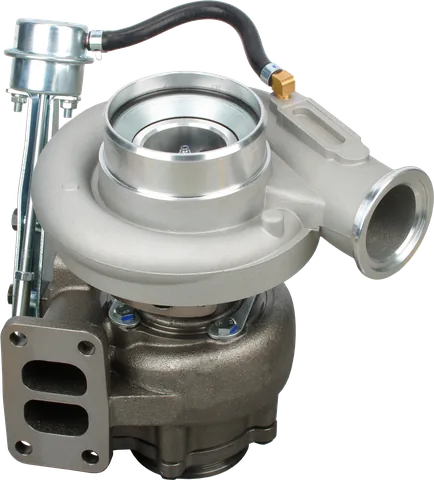
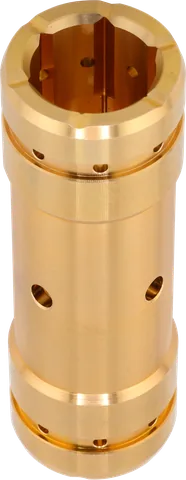
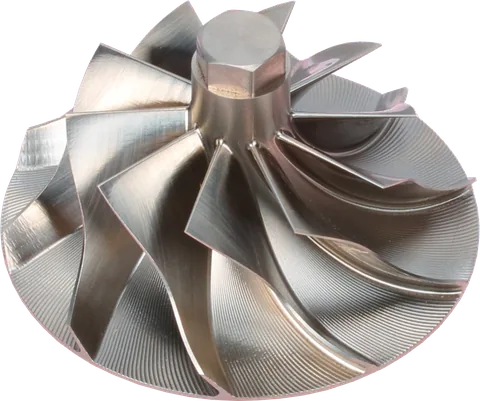
For a buyer comparing twin scroll vs single scroll turbo designs, the key distinction is on the exhaust side. A twin-scroll turbocharger uses two turbine inlet passages to manage exhaust pulses from different cylinder groups. It still has one turbine wheel driving one compressor wheel.
That arrangement can improve response and low-speed torque when the engine, manifold, and turbocharger are designed together. It does not automatically make a turbo more powerful, more durable, or interchangeable with a single-scroll unit.
How Does a Twin-Scroll Turbocharger Work?
A single-scroll turbine housing has one shared spiral-shaped exhaust passage, or volute, directing gas toward the turbine wheel. Exhaust from the connected cylinders enters that common passage.
A twin-scroll turbo has a divided turbine housing. Two passages keep selected exhaust streams separated as they approach the same turbine wheel. A matching divided manifold routes the appropriate cylinders into each passage.
The divider therefore does more than split the inlet opening. It forms part of an exhaust-routing system that starts at the engine’s exhaust ports.
A divided-looking flange alone does not establish that the entire installation preserves pulse separation. An open collector, unsuitable gasket, or adapter that joins the streams before the turbine can compromise the intended operation.
When comparing twin scroll vs single scroll turbocharger housings for replacement, use the turbo’s identification and application data. Housing appearance is only one check.
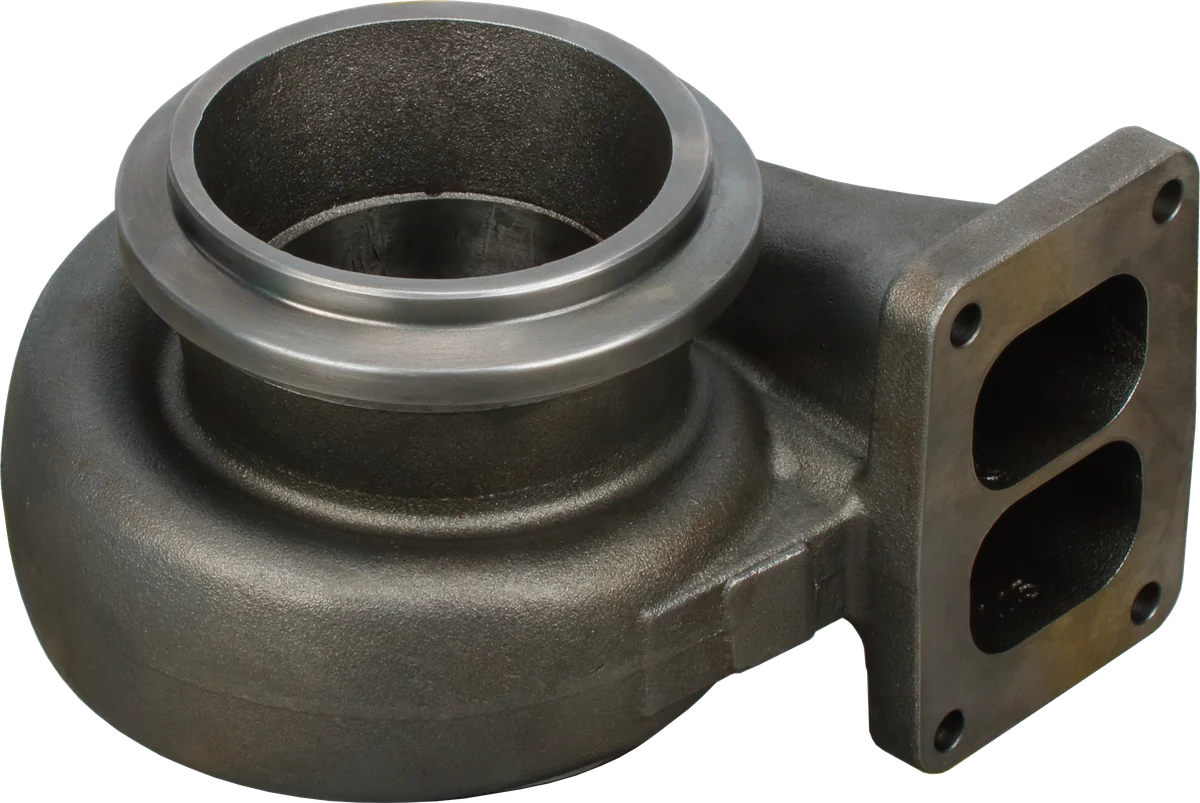
First exhaust inlet: feeds one scroll.
Second exhaust inlet: feeds the other scroll.
Divider: keeps the two inlet passages separate.
Product photograph from 2026. Numbers identify the features explained below.
Why Exhaust Pulse Interference Matters
Exhaust does not leave each cylinder as a steady stream. When an exhaust valve opens, cylinder pressure produces a strong initial discharge, followed by the rest of the exhaust event. Each cylinder sends a pressure pulse into the manifold.
In a shared manifold, those pressure waves can reach other runners. A strong pulse from one cylinder can raise pressure at another cylinder’s exhaust port while its exhaust valve is still open. Depending on valve timing and pressure conditions, this can hinder exhaust clearing or encourage gas to move in the wrong direction.
Twin-scroll routing groups cylinders according to their firing sequence so that closely spaced firing events feed different scrolls. This reduces unwanted interaction between those events and helps preserve useful pulse energy at the turbine.
For example, when specifying a twin-scroll turbo for inline-four engines, a common grouping on an evenly firing engine with a 1-3-4-2 firing order is cylinders 1 and 4 in one scroll and 2 and 3 in the other. Successive firing events alternate between the scrolls.
That example is not a universal manifold recipe. Other cylinder counts and firing arrangements require their own grouping. On some engines, routing the ideal groups is more difficult than simply collecting each cylinder bank together.
Pulse vs. Constant-Pressure Turbocharging
These terms describe how the exhaust system delivers energy to the turbine.
Pulse turbocharging aims to preserve the pressure changes created by individual exhaust events. Appropriately sized runners and cylinder grouping help deliver distinct pulses instead of allowing them to mix and weaken in a large collector.
Constant-pressure turbocharging uses a shared exhaust volume to smooth those fluctuations before the gas reaches the turbine. “Constant” means comparatively steady; it does not mean pressure never changes with load or engine speed. Steadier flow can suit efficient turbine operation, while mixing reduces some of the energy available from individual pulses.
Twin-scroll systems support pulse turbocharging by keeping selected streams apart. However, single-scroll does not automatically mean constant-pressure. A single-scroll turbo connected to a compact manifold can still receive strongly pulsating flow.
The practical distinction is how much pulse separation and smoothing the complete exhaust arrangement creates—not just how many openings are visible at the turbo inlet.
What Benefits Matter in a twin scroll vs single scroll turbo Comparison?
A well-matched twin-scroll system can offer three useful benefits:
- Better response: Preserving exhaust pulses can help the turbine accelerate when the driver requests more load, especially where exhaust flow is limited.
- Stronger low-speed torque: If the turbo supplies useful airflow earlier in the engine’s operating range, the engine can develop more torque there within its fueling and control limits.
- Improved scavenging conditions: Reducing pressure interference can help cylinders clear residual exhaust. Where valve timing and pressure differences permit, this also supports incoming fresh charge during valve overlap.
These are system-level benefits. They depend on turbine sizing, manifold volume, valve timing, boost control, and calibration.
A larger twin-scroll turbo can still respond more slowly than a smaller single-scroll turbo. Likewise, twin-scroll construction does not establish maximum airflow or peak power. For a closer look at delayed boost response, see what causes turbo lag.
Drawbacks: Cost, Packaging, and Thermal Stress
The added separation brings practical compromises.
Cost and manifold complexity: A divided housing and correctly grouped manifold generally require more design and manufacturing effort. Packaging the runners can be difficult in a crowded engine compartment, and replacement choices may be narrower.
Compatibility requirements: Matching the bolt pattern is insufficient. The manifold divider, turbine inlet, gasket opening, and any adapter must work together. Wastegate routing also matters because bypass flow must control the intended exhaust streams.
Heat management: Both housing types handle severe exhaust heat. Twin-scroll construction does not inherently mean a hotter-running engine, but its internal divider adds geometry that experiences uneven heating and cooling. Material, casting design, exhaust temperature, and duty cycle affect durability.
Cracking between scrolls: Repeated thermal expansion and contraction can stress the divider and nearby housing sections. A crack may allow communication between passages, extend toward another feature, or eventually threaten structural integrity. Its significance depends on its location and extent.
A correctly specified single-scroll turbo remains a sensible choice when that is what the engine was designed to use.
Twin-Scroll vs. Twin-Turbo vs. Two-Stage
These labels answer different questions: how exhaust enters a turbine, how many turbos are fitted, and how compression is arranged.
| Term | What it describes | How it works | Buyer takeaway |
|---|---|---|---|
| Single-scroll | Turbine housing layout | One shared exhaust passage feeds a turbine wheel. | Match the housing and manifold specification. |
| Twin-scroll | Turbine housing layout | Two separated exhaust passages feed one turbine wheel. | One twin-scroll unit is still one turbocharger. |
| Twin-turbo, parallel | Two turbochargers operating in parallel | Exhaust flow is divided between turbos; their compressors supply the engine in parallel. | Turbo count does not identify scroll type. |
| Sequential turbocharging | How turbochargers are brought into operation | Valves and controls change which turbochargers contribute as operating conditions change. | “Sequential” alone does not establish series compression. |
| Two-stage or compound turbocharging | Compression through successive stages | Air compressed by one stage enters another for further compression. | It is not equivalent to two parallel turbos or two scrolls. |
A twin-turbo system can use twin-scroll turbine housings. Likewise, a two-stage system may bypass or unload a stage under certain conditions.
For more detail on these arrangements, read two-stage and sequential turbocharging explained.
Replacement Advice: Match the OE Housing and Manifold
For a stock repair, the twin scroll vs single scroll turbo choice should match the original equipment housing type and manifold arrangement. Do not treat twin-scroll as a universal upgrade or single-scroll as an acceptable substitute merely because the mounting bolts line up.
Confirm these points before ordering:
- Turbo identification: Record the complete part number and any relevant revision. Start with how to identify a turbocharger part number.
- Vehicle application: Verify engine, model year, and applicable production or equipment differences.
- Turbine inlet: Check whether it is open or divided, along with flange shape and divider position.
- Housing specification: Match the approved turbine housing, outlet connection, and installation orientation.
- Boost control: Confirm the wastegate or other control arrangement, actuator compatibility, and any required calibration procedure.
- Supporting connections: Check oil and coolant connections, compressor plumbing, brackets, and heat shields.
Use the turbo fitment guide to organize those checks.
Installing a twin-scroll turbocharger with an open manifold generally sacrifices the intended pulse separation. Installing an open housing behind a divided manifold changes the exhaust system’s designed behavior. Either conversion needs engineering assessment beyond physical fit.
If the existing turbine housing is damaged, compare CHRA versus complete turbocharger replacement. A new core cannot restore a cracked housing divider.
What Are Twin-Scroll Turbocharger Crack Symptoms?
Cracks may appear around the divider, inlet, wastegate region, or other highly stressed areas. Some are visible only after removal and suitable cleaning.
Possible warning signs include:
- A visible line or opening through the scroll divider.
- Missing material, an eroded divider edge, or a loose fragment.
- Soot tracks outside the housing or around a connected joint.
- Exhaust ticking or puffing that changes with load.
- Slower boost response or an underboost complaint without an obvious intake leak.
- Wheel-contact marks or evidence that damaged housing material has reached the turbine.
These clues need interpretation. An internal divider crack may leave no external soot. A leaking manifold gasket can produce similar noise and deposits. Underboost can also result from charge-air leaks, actuator faults, or other engine problems.
Inspect with the engine cold. Avoid grinding suspected cracks away or attempting a generic weld repair. Housing condition must be judged against the applicable manufacturer’s service criteria; specialist inspection may be needed to establish crack extent.
If material is missing or there is evidence of wheel contact, stop treating the problem as a simple sealing issue. Investigate the turbine and downstream path as appropriate. Follow a broader failed-turbo diagnosis process before buying parts.
Common Questions
Does twin-scroll mean twin-turbo?
No. Twin-scroll describes two exhaust passages feeding one turbine wheel inside a turbocharger. Twin-turbo means an engine has two turbochargers. Either turbocharger in a twin-turbo system could itself use a single-scroll or twin-scroll turbine housing.
Does a twin-scroll turbo always spool faster?
No. A properly matched twin-scroll system can improve response by preserving exhaust pulses, but turbine size, rotor inertia, manifold design, boost control, and engine operating conditions also matter. The twin-scroll label alone does not establish how quickly a turbo will respond.
Can I replace a single-scroll turbo with a twin-scroll unit?
Treat that as an engineered conversion, not a routine replacement. You need a compatible divided manifold with correct cylinder grouping, suitable connections, and compatible boost control and calibration. For a normal repair, match the original housing type and verified turbocharger application.
Is every single-scroll system constant-pressure turbocharging?
No. A single-scroll turbine can still receive strong exhaust pulses through a compact manifold. Constant-pressure turbocharging deliberately smooths those pulses in a shared exhaust volume. Scroll count and pulse behavior are related, but they are not interchangeable descriptions.
Can a CHRA replacement fix a cracked scroll divider?
No. The divider belongs to the turbine housing, which is outside the CHRA. Replacing the rotating core leaves that crack in place. The housing needs assessment against the manufacturer’s criteria, followed by an approved housing replacement or a suitable complete turbocharger.
Does a crack between scrolls always cause a boost problem?
No. The effect depends on the crack’s location, depth, and extent. Some cracks may have little immediate effect; others allow crossflow, exhaust leakage, or structural damage. Visible cracking needs assessment, and normal boost does not prove the housing is serviceable.
Can I replace just the turbocharger housing?
The housing needs assessment against the manufacturer’s criteria. Use an approved housing replacement or a suitable complete turbocharger. Replacing the CHRA cannot restore a cracked scroll divider.
Need help with your twin scroll vs single scroll turbo choice? Contact LeadTurbo with your turbo part number, vehicle details, and symptoms.