An aftermarket vs OEM turbo comparison is useful only when it checks application fit, manufacturing control, and the evidence behind a new or remanufactured unit.
For a fleet truck, bus, or loader, a replacement has to do more than bolt on and make boost. The purchase also needs to control repeat labor, downtime, and application errors. When evaluating an aftermarket turbocharger for fleet trucks or other equipment, quality comes from the specification and the process behind the unit, along with the supplier's ability to support what it sells.
What are you actually buying?
In an aftermarket vs OEM turbocharger comparison, source and condition are separate questions. An original manufacturer's reman is still remanufactured; an independent supplier can sell either new or restored equipment.
- OEM/genuine, new: Supplied by the engine maker or its original turbo manufacturer to the correct original equipment specification. Verify the application and origin; “OEM replacement” alone does not establish genuine supply.
- New aftermarket: A new turbocharger from another manufacturer, built to replace the original at its mounting, air, exhaust, oil, and control connections. Matching those interfaces does not establish equivalent internal design or performance.
- Remanufactured/rebuilt: A used core restored with new wear parts. Proper remanufacturing follows defined inspection, rejection, assembly, and testing standards. A quick rebuild may replace obvious damaged parts without evaluating the whole unit.
Here, aftermarket means a direct replacement. An upgrade that intentionally changes airflow or control behavior requires a separate matching decision.
These are typical buying considerations; actual value depends on the specific product and supplier:
| Source | Purchase price | Consistency | Warranty considerations | Main buying risk |
|---|---|---|---|---|
| New OEM/genuine | Usually highest | Usually strong application control and traceability | Check written coverage, including labor | Wrong specification or installation faults still matter |
| New aftermarket | Often lower | Depends on manufacturing and batch controls | Terms vary by supplier | Unverified materials, performance, or calibration |
| Remanufactured | Often lower; core charges may apply | Depends on core rejection and restoration standards | Terms vary by program | Hidden core damage or incomplete restoration |
For a remanufactured vs new turbocharger comparison, include the core deposit, return freight, and any charges for an unacceptable core.
What matters in an aftermarket vs OEM turbo comparison?
A matching flange proves little about behavior on a loaded engine. Ask what validates the design, then how production units are checked. Development testing and final inspection answer different questions.
Start with the intended engine. Matching tests establish airflow, boost response, and exhaust restriction across its operating range. Emissions validation must also address the turbo's interaction with EGR and aftertreatment systems where fitted. Altitude, operation on slopes, and cold starts can expose problems that a warm workshop check misses.
Within the turbo design, blade vibration checks look for fatigue-prone resonance. Spin and burst testing establish wheel strength margins; containment testing evaluates the housing's ability to retain debris during a defined wheel failure. Thermal deformation checks address changing clearances, while rotor stability tests examine shaft-and-bearing behavior. Seal tests assess leakage under operating pressure conditions. Aerodynamic testing establishes compressor and turbine flow and efficiency.
Durability testing asks whether the complete turbocharger survives continuous loaded operation and repeated hot-cold cycles. Controlled poor-oil tests investigate contamination and deposit sensitivity. Vibration and dust exposure examine resistance to harsh equipment environments. Passing these tests does not make neglected maintenance acceptable.
Equipment, destructive samples, engineering time, and design revisions cost money. A cheap copy may reproduce visible geometry while skipping validation. A responsible aftermarket manufacturer can validate its own design, and legitimate savings can also come from manufacturing scale or distribution costs.
Production evidence might include material traceability, dimensional inspection, and final test records. Those checks help establish whether shipped units consistently meet the validated specification.
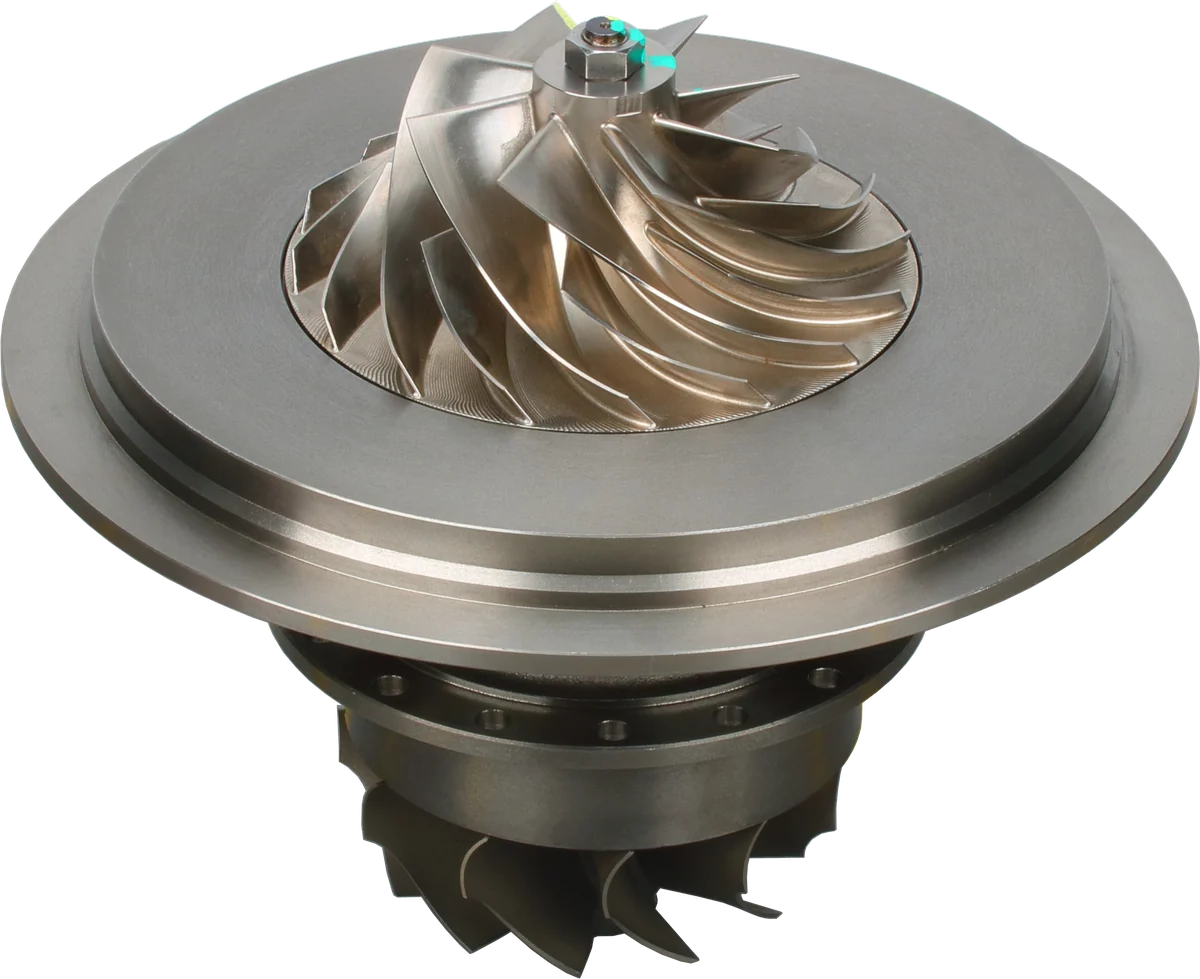
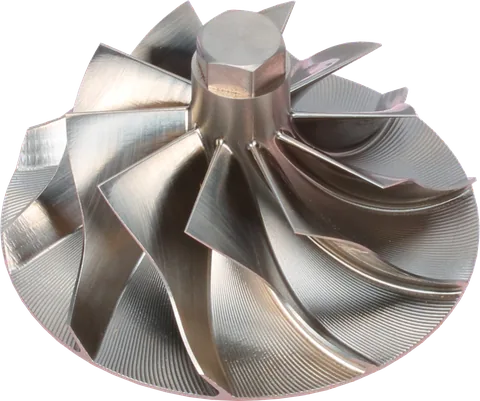
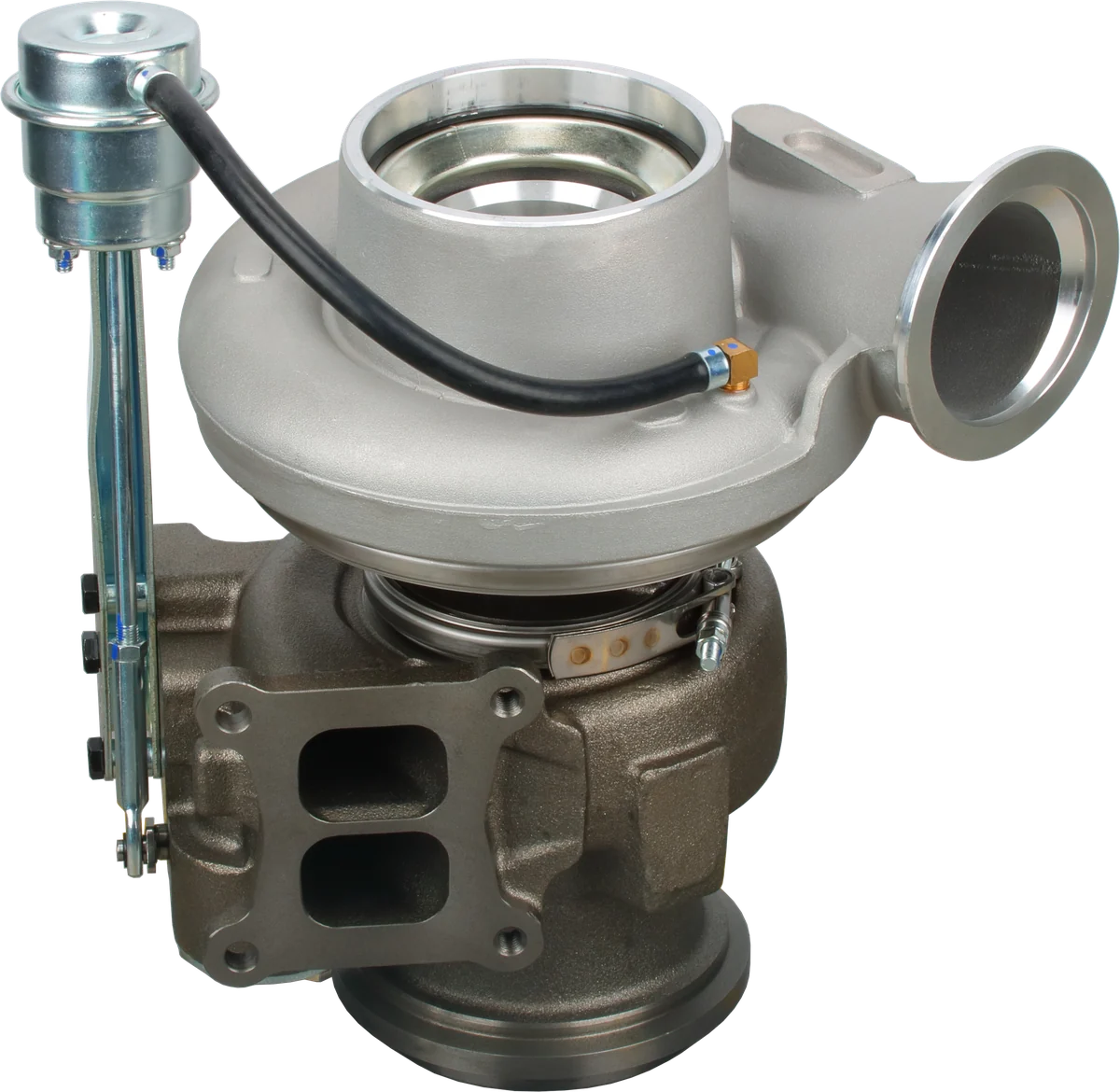
Compressor wheel: transfers shaft power to the air.
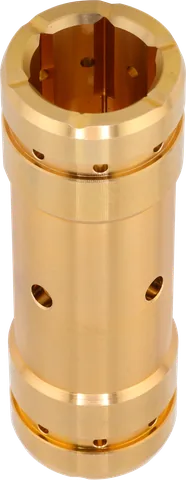
Bearing housing: supports the lubricated rotating assembly.
Turbine wheel: exhaust energy drives the shaft.
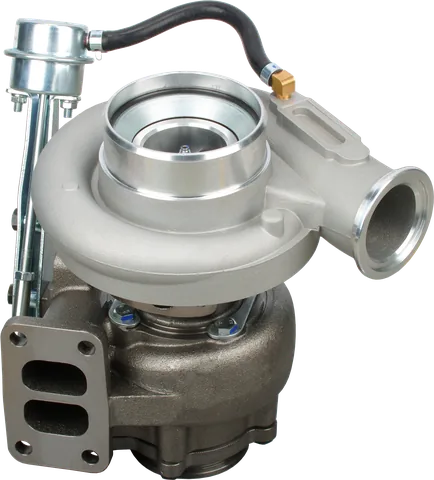
Product photograph from 2026. Numbers identify the features explained below.
How to check aftermarket turbocharger quality
Aftermarket turbocharger quality depends on controls that rarely show in a product photo. A low price can hide these common shortcuts:
- Wheels: Unverified alloy, casting defects, or inconsistent heat treatment can undermine strength even when blade shapes look convincing.
- Balancing: Individually balanced wheels do not prove that the assembled rotating group meets its balance requirements.
- Bearings and seals: Poor machining, unsuitable materials, or inconsistent seal-ring geometry can compromise lubrication and leakage control.
- Housings: The wrong alloy or weak casting control can reduce resistance to heat distortion and cracking.
- Actuators: An installed actuator may lack the required wastegate setting or VGT flow calibration.
- Aerodynamics: Similar wheel diameters do not establish the original operating map; response, backpressure, and efficiency may change.
Peak boost alone is weak evidence of equivalence. Two units can reach similar manifold pressure while operating at different efficiency or exhaust restriction.
What a proper reman should include
Evaluate a remanufactured turbo by its documented restoration process. Fresh paint and a new bearing kit do not establish that the remaining core is serviceable.
Look for:
- Thorough cleaning, including internal oil passages, followed by appropriate crack inspection.
- Recorded measurements of shaft journals, straightness, bearing bores, and seal areas against applicable specifications.
- New bearings, seals, thrust components, and other specified single-use parts.
- New wheels, or reused wheels certified serviceable through documented inspection and acceptance criteria.
- Balancing and verification of the assembled core, with high-speed checks where required by that turbo design.
- Appropriate leak testing and checks of housing condition, fit, and orientation.
- Actuator inspection, setting, and VGT flow calibration where applicable.
Rejecting an unsuitable core is part of the job. New bearings cannot correct a damaged shaft or an out-of-specification housing bore. Ask what the rebuilder refuses to reuse and how replacement components are identified.
“Rebuilt” can describe careful work, but the label alone tells you little about its scope.
What to ask aftermarket turbocharger suppliers
Ask these questions of any supplier, including one selling genuine units. A useful answer identifies a process, specification, or record instead of relying on adjectives. Confirm aftermarket turbocharger warranty coverage in writing.
| Question | Good answer | Weak answer |
|---|---|---|
| What confirms this exact application? | Verified turbo number, documented supersession, and engine/control details | “It fits that engine family.” |
| Can you trace the unit and its parts? | Serial or batch identification tied to manufacturing or reman records | “Everything comes from the same factory.” |
| What design and production checks support it? | Relevant design validation plus defined final inspection procedures | “OEM quality,” with no explanation |
| What is balanced? | Assembled-core verification appropriate to the design, with traceable results | “The wheels arrive balanced.” |
| What does your reman process replace and reject? | Written wear-part replacement and measured core acceptance criteria | “Cleaned and rebuilt as needed.” |
| How is the actuator set? | Application-specific calibration and instructions for any required learning procedure | “Adjust the rod until boost looks right.” |
| What happens if there is a problem? | Written coverage, exclusions, claim steps, and replacement timing | “Send it back and we will decide.” |
A generic certificate or unrelated balance printout is weak evidence. Ask how the records connect to the unit being shipped. Proprietary development details may remain confidential, but the supplier should explain its quality-control basis.
Check the delivery before it reaches the engine
Keep packaging and photograph the identification tag. These checks catch shipping damage and specification problems; they cannot verify internal metallurgy or long-term durability.
- Identity: Match the tag, invoice, and ordered number. A different number needs a documented interchange or supersession.
- Rotor condition: Look for damaged blades or wheel-to-housing contact marks. If permitted by the supplier, turn the rotor gently by hand; scraping or binding needs investigation.
- Play: Some dry journal-bearing movement can be normal. Compare measured radial and axial movement with exact service limits; finger feel alone cannot approve a turbo.
- Controls: Confirm the correct connector, actuator, and calibration documentation. Do not alter rods or stop screws to make a mismatch fit.
- Completeness: Check ordered gaskets, hardware, port protection, and mounting orientation. Missing promised gaskets require follow-up, although separately sold gaskets are not evidence of poor manufacture.
Resolve discrepancies before installation. Use OEM service data for the exact turbo rather than a universal clearance or adjustment value.
Which option fits the equipment and the job?
An aftermarket vs OEM turbo decision should account for repeat labor and downtime as well as the invoice price.
| Application | Sensible priority | Reason |
|---|---|---|
| Newer electronic-VGT truck or bus | Verified application, control compatibility, and calibration across any source | Engine and emissions-system requirements make an approximate match risky |
| Older mechanical farm tractor or pickup | Documented new aftermarket or a properly remanufactured original core | Either can control cost while retaining the specified match |
| Working fleet or remote construction equipment | Traceability, available stock, and a clear replacement process | A second removal can erase purchase savings |
| Marine propulsion or generator set | Validation for the exact duty and installation | Rated output alone does not establish suitability for sustained loading |
Genuine parts can make sense when application certainty and support justify the premium. Aftermarket and reman can offer good value when their quality controls are credible. On a limited budget, compare documented options before accepting an anonymous bargain.
Whichever route you choose, establish why the previous turbo failed. Oil-supply faults, intake debris, or control problems can damage even a well-built replacement.
Common Questions
Is a new aftermarket turbo always lower quality?
No. A capable manufacturer can supply a reliable replacement with the correct performance and quality controls. Evaluate application evidence, traceability, assembly testing, and support. Price and appearance alone cannot establish equivalence.
Remanufactured vs rebuilt turbocharger: what's the difference?
The labels overlap in the marketplace. Ask for the actual process: what is measured, which parts are replaced, what causes core rejection, and how the finished unit is tested. A documented standard matters more than the label.
Does a replacement electronic actuator need calibration?
It needs the correct setup for the turbo and application. Bench calibration and an installation or learning procedure on the engine may be separate requirements. Confirm both with the supplier and the applicable service information.
Does noticeable shaft play mean a new turbo is defective?
Not automatically. A dry journal-bearing turbo may have perceptible radial clearance before oil pressure is established. Scraping, binding, or movement outside the specified limits requires investigation. Use the exact model's service data instead of a universal clearance rule.
How should a fleet compare aftermarket vs OEM turbo costs?
Compare the installed cost, including labor, required setup, shipping, core charges, and downtime. Read the warranty's exclusions and replacement procedure. A lower purchase price is useful only when the unit meets the application and the supplier can support it.
Why does my aftermarket turbo underperform?
Matching connections does not establish equivalent performance. The operating map may differ, and an actuator may lack the required setting or VGT flow calibration.
LeadTurbo supplies complete turbochargers, CHRAs/cores and repair kits. Send LeadTurbo the turbo part number, engine details and photos for help confirming the right part.